
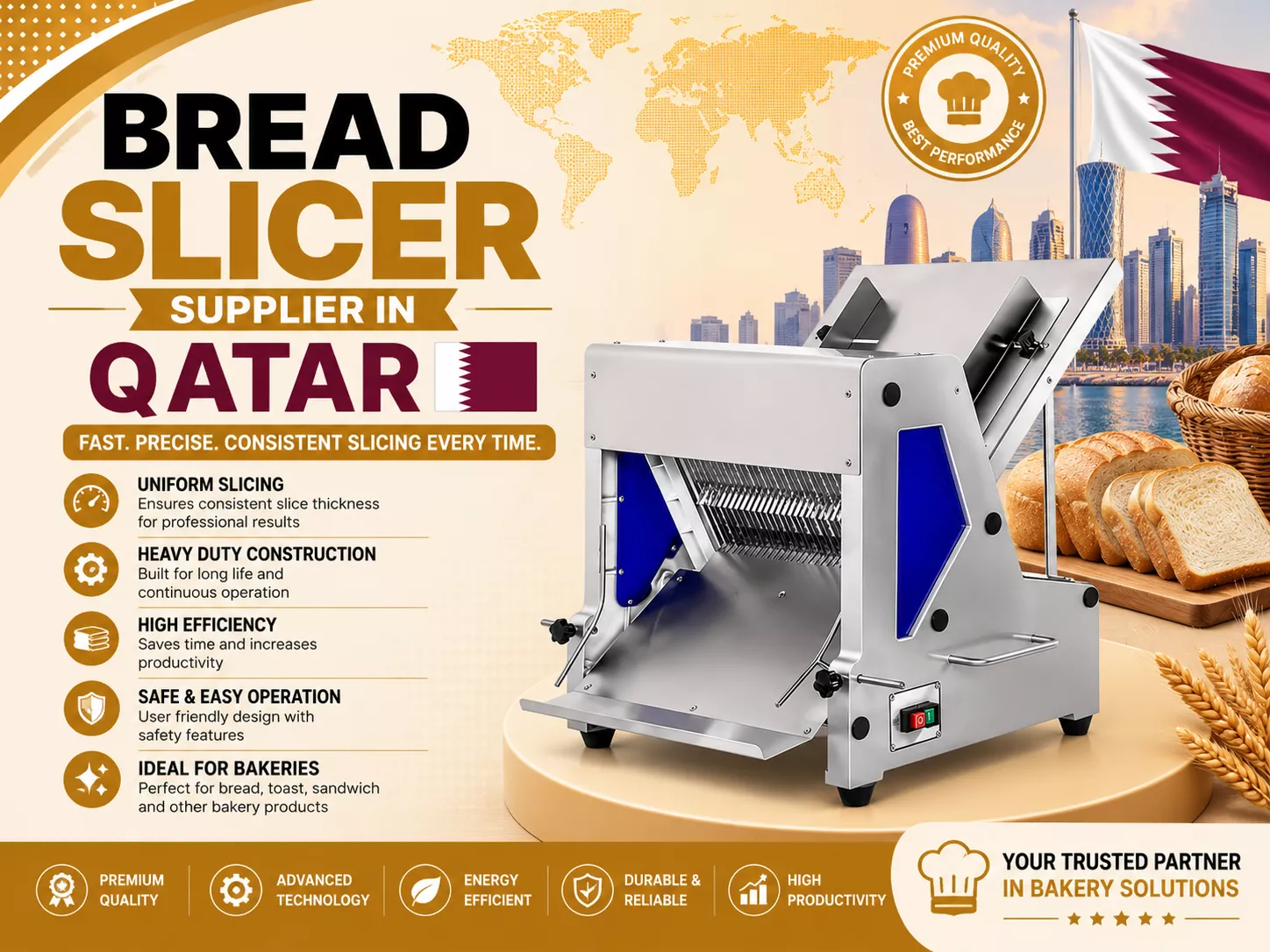
Bread Slicer Supplier in Qatar
A Complete Guide to Choosing the Right Commercial Bread Slicing Machine
Choosing the right Bread Slicer Supplier in Qatar is an important decision for bakeries, supermarkets, hotels, restaurants, cafés, catering companies, central kitchens, and commercial food-production facilities. Bread slicing may appear to be a simple finishing operation, but in a busy bakery, the slicing process affects product presentation, portion consistency, packaging speed, labor requirements, and overall production efficiency.
A commercial bread slicer is designed to cut loaves into consistent slices at a controlled thickness. Depending on the machine design, it can be operated manually, semi-automatically, or automatically. Some models are intended for smaller bakery operations, while high-speed systems are designed for continuous production lines.
The right machine depends on the type and size of bread being produced, desired slice thickness, daily production volume, available floor space, electrical supply, operator workflow, and required level of automation.
This guide explains what a commercial bread slicer does, how to choose the right model, which specifications deserve attention, and what buyers should check when evaluating a Bread Slicer Supplier in Qatar.
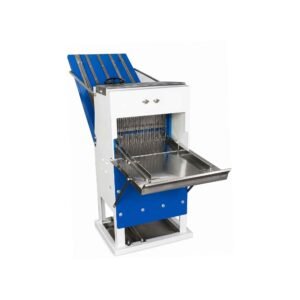
Single Bread Slicer Machine
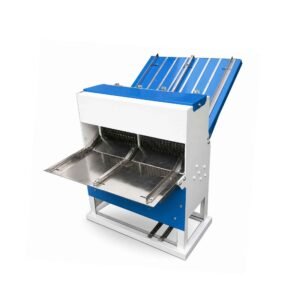
High Speed Bread Slicer
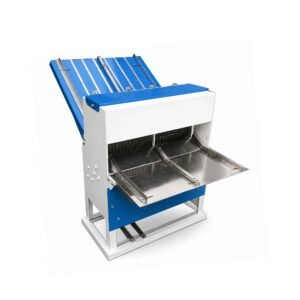
Bread Slicer Machine
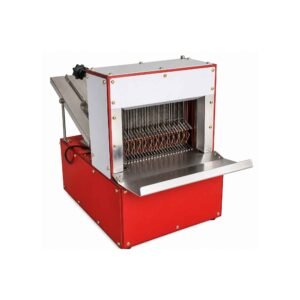
Table Top Bread Slicer Machine
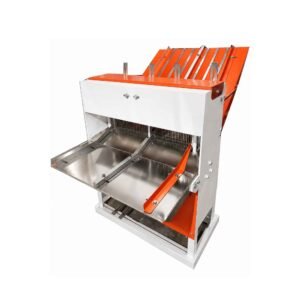
Rusk Cutting Machine
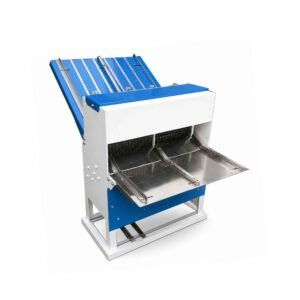
Rusk Cutter Machine
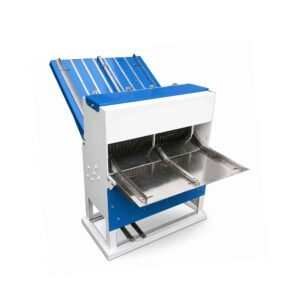
Double Bread Slicer Machine
What Is a Commercial Bread Slicer?
A commercial bread slicer is a bakery machine designed to divide a baked loaf into multiple uniform slices. Instead of relying on manual cutting, the machine uses a set of blades or a slicing mechanism to produce repeatable results.
Uniform slicing is particularly important for packaged bread because customers generally expect slices to have a consistent appearance and thickness. Consistent slices can also make downstream packaging and product presentation easier.
Commercial bread slicers are available in different configurations, including tabletop machines, freestanding machines, automatic slicers, and conveyor-based systems. Qatar’s commercial bakery-equipment market currently includes both tabletop and freestanding bread slicer options.
A knowledgeable Bread Slicer Supplier in Qatar should first understand the loaf dimensions and production requirement before recommending a machine.
Contact Sri Brothers Enterprises today to discuss your bread slicer requirement and request a quotation.
Why Is a Bread Slicer Important for a Bakery?
In small bakeries, bread may initially be sliced manually. As production increases, however, manual slicing can become time-consuming and difficult to standardize.
A commercial slicer can help with:
- Consistent slice thickness
- Faster bread preparation
- Reduced manual cutting
- Improved product presentation
- More predictable packaging
- Better production workflow
- Reduced variation between batches
The actual output depends on the machine, loaf dimensions, bread characteristics, operator method, and manufacturer’s rated capacity.
For this reason, buyers should not judge a bread slicer only by an advertised “loaves per hour” figure. The specification should be considered together with the type and size of bread being sliced.
How Does a Bread Slicing Machine Work?
The operating process varies according to the machine configuration.
In a basic commercial slicer, the operator positions the loaf correctly and feeds it through the cutting mechanism. The blades then divide the loaf into slices.
Automatic and conveyor-style systems can incorporate guided product movement and automated feeding. These configurations are more appropriate when slicing is part of a larger production line.
The basic process can be understood as:
Baked Loaf → Positioning → Slicing → Slice Collection → Packaging
Before selecting a Bread Slicer Supplier in Qatar, a bakery should identify where the slicer will be placed in this workflow.
For example, a small retail bakery may need a compact tabletop machine near the packaging area, while a high-volume bread plant may require an automatic conveyor slicer integrated with the packaging line.
What Types of Bread Can Be Sliced?
The suitable bread type depends on the slicer’s design and operating specifications.
Potential applications can include:
- Sandwich bread
- White bread
- Whole-wheat bread
- Multigrain bread
- Toast bread
- Loaf bread
- Specialty bread
- Certain cakes or bar-shaped bakery products on machines designed for such applications
Not every slicer is suitable for every loaf.
Bread texture, crust hardness, loaf height, loaf length, moisture level, and cooling condition can influence slicing performance. A very soft or freshly baked loaf may behave differently from a fully cooled commercial loaf.
Therefore, when working with a Bread Slicer Supplier in Qatar, provide the actual dimensions and characteristics of the bread you manufacture.
Why Slice Thickness Matters
Slice thickness is one of the most important specifications when purchasing a bread slicer.
Different products and customers may require different slice sizes. Sandwich bread, toast, specialty bread, and foodservice products may have different requirements.
Some commercial bread slicers offer a fixed slicing thickness, while others provide adjustable options. For example, one Qatar-market tabletop bread slicer listing specifies 11 mm and 13 mm slice thickness options.
Other commercial machines are designed with adjustable thickness ranges. The correct configuration depends on the intended product.
A Bread Slicer Supplier in Qatar should confirm whether the required slice thickness is available before the purchase.
Tabletop Bread Slicer vs Floor-Standing Bread Slicer
The physical format of the machine should match the bakery’s production environment.
Tabletop Bread Slicer
A tabletop slicer is generally more suitable where:
- Production volume is moderate
- Floor space is limited
- The machine needs to be positioned on a work surface
- Manual or operator-assisted feeding is acceptable
A Qatar-market example from RIT lists a tabletop electric bread slicer with a 42 cm cutting width, 11/13 mm slice options, 0.55 kW power, and compact dimensions. These are model-specific figures and should not be assumed for every tabletop slicer.
Floor-Standing Bread Slicer
A floor-standing machine may be more suitable for larger bakeries where production volume and operator workflow justify a larger footprint.
These machines can provide additional working space, larger feeding arrangements, or greater production capability depending on the model.
Before choosing a Bread Slicer Supplier in Qatar, measure the available installation area and consider operator access around the machine.
Automatic vs Manual Bread Slicer
Automation level should be selected according to production volume.
Manual Bread Slicer
Manual machines can be useful for smaller operations where the operator controls the feeding and slicing process.
Advantages may include:
- Lower equipment complexity
- Simple operation
- Suitable for smaller production
- Lower space requirement
Semi-Automatic Bread Slicer
A semi-automatic system can reduce some manual work while still requiring operator involvement.
It may be suitable for bakeries that have moderate production but do not require a fully automated line.
Automatic Bread Slicer
Automatic machines are designed to reduce operator intervention and can be integrated into higher-volume production systems.
Industrial slicers may use conveyors and automated product positioning. One published industrial example specifies capacities ranging from 1,000 to 1,500 loaves per hour depending on the model, while a smaller tabletop model is rated at 500 loaves per hour for a specified loaf size.
These figures illustrate why capacity should always be considered model-specific and product-specific.
How to Choose Bread Slicer Capacity
Capacity should be calculated according to actual bakery production.
Suppose a bakery produces 800 loaves during a particular production period. If the selected slicer can process the required loaf format at approximately 400 loaves per hour, the theoretical slicing time would be around two hours.
However, actual workflow may take longer because of:
- Loaf loading
- Positioning
- Product handling
- Packaging
- Operator movement
- Cleaning
- Machine adjustments
Therefore, the rated capacity should not be treated as guaranteed real-world output.
When comparing a Bread Slicer Supplier in Qatar, ask for capacity based on the actual loaf dimensions and weight used by your bakery.
Important Bread Slicer Specifications
A technical specification sheet is essential before purchasing commercial bakery equipment.
Cutting Width
Cutting width determines the maximum loaf width the machine is designed to accommodate.
Loaf Height
Check the minimum and maximum loaf height supported by the machine.
A published industrial slicer example specifies a loaf-height range of 75–130 mm for two different models.
Loaf Length
The maximum bread length should be compared with the actual products being manufactured.
Slice Thickness
Confirm whether the machine provides a fixed thickness or adjustable slicing.
Number of Blades
Blade configuration can vary between machine designs and influences how the loaf is divided.
Production Capacity
Capacity may be stated in loaves per hour, slices per minute, or another unit. Always ask what loaf size was used to determine the rated output.
Motor Power
Motor power should be evaluated according to the complete machine design and production requirement.
Voltage and Phase
Confirm the required voltage, frequency, and single- or three-phase electrical supply before installation.
Machine Dimensions
The machine must fit the production area with sufficient clearance for operators and maintenance.
Machine Weight
Weight becomes particularly important during delivery and installation of larger floor-standing machines.
Blade Material
Ask about blade material, durability, replacement procedure, and availability of spare blades.
Safety System
Operator safety should be considered when evaluating the cutting mechanism, protective covers, emergency controls, and machine interlocks.
Bread Cooling and Slicing Quality
An important practical consideration is the condition of the bread before slicing.
Bread should generally be handled according to the production process and the equipment manufacturer’s requirements. Slicing characteristics can change depending on the loaf’s temperature, moisture content, crumb structure, and crust condition.
If a bakery experiences crushing, tearing, irregular slices, or excessive crumbs, the problem may not necessarily be the slicer itself. Product condition, blade condition, loaf alignment, machine settings, and handling practices should also be evaluated.
This is where practical equipment knowledge becomes valuable. A reliable Bread Slicer Supplier in Qatar should be able to discuss the relationship between the machine and the bakery’s actual product rather than treating the slicer as an isolated piece of equipment.
Blade Maintenance and Replacement
Blades are working components and require appropriate care.
Depending on the machine design and usage, maintenance may involve:
- Regular inspection
- Cleaning according to manufacturer instructions
- Checking blade condition
- Checking blade alignment
- Replacing worn components
- Inspecting guards and safety mechanisms
Blade life depends on factors such as bread type, production volume, machine design, cleaning practices, and operating conditions.
Avoid assuming a fixed blade-replacement interval unless it is provided by the manufacturer.
Before purchasing, ask the Bread Slicer Supplier in Qatar about spare blade availability and the recommended replacement procedure.
Hygiene Considerations
Bread slicing takes place after baking, so hygiene remains important.
A commercial slicer should allow operators to follow appropriate food-safety and cleaning procedures.
Important considerations include:
- Accessible product-contact areas
- Easy-to-clean surfaces
- Crumb collection
- Removable components where applicable
- Suitable construction materials
- Protected electrical components
- Safe blade access during cleaning and maintenance
Some commercial bread slicers are specifically designed with stainless-steel construction and crumb-management features.
The manufacturer’s cleaning instructions should always take priority because cleaning procedures differ between machine designs.
Electrical Requirements for Qatar Installations
Electrical compatibility should be checked before ordering.
Depending on the machine, specifications may include:
- Voltage
- Frequency
- Single-phase or three-phase supply
- Installed power
- Plug and connection requirements
For example, one Qatar-market tabletop slicer is listed with a 240 V / 0.55 kW configuration, while an industrial slicer example uses 415 V / three-phase / 50 Hz.
These examples demonstrate why electrical requirements cannot be assumed from the product category. The exact model specification should be confirmed before installation.
Installation Planning
Before delivery, prepare the installation area.
Check:
Floor Space:
Ensure the machine has enough room for safe operation.
Access Route:
Measure doors, corridors, elevators, and other access points.
Electrical Connection:
Confirm that the required electrical supply is available.
Operator Clearance:
Allow sufficient space for loading and unloading bread.
Maintenance Access:
Technicians should be able to access relevant components when servicing is required.
Packaging Area:
Position the slicer so sliced bread can move efficiently toward packaging or storage.
A professional Bread Slicer Supplier in Qatar should provide machine dimensions and installation requirements before delivery.
How Much Does a Bread Slicer Cost in Qatar?
The price of a commercial bread slicer varies according to the machine’s specifications and configuration.
Factors that can affect the final quotation include:
- Machine type
- Automatic or manual operation
- Loaf capacity
- Production speed
- Slice thickness
- Number of blades
- Construction material
- Motor power
- Conveyor system
- Safety features
- Manufacturer
- Shipping
- Installation
- Warranty
- Spare-parts support
For this reason, there is no single price that accurately represents every commercial bread slicer in Qatar.
When requesting a quotation from a Bread Slicer Supplier in Qatar, provide the exact product dimensions, desired slice thickness, daily production, peak production, and automation requirements.
This allows suppliers to quote a more appropriate machine instead of giving a generic price for an unspecified configuration.
How to Select a Bread Slicer Supplier in Qatar
The supplier is almost as important as the machine.
A good supplier should be able to explain:
- Which slicer matches your loaf dimensions
- What capacity is realistic
- Which slice thickness is available
- What electrical supply is required
- What installation preparation is necessary
- How the machine should be maintained
- Which spare parts are available
- What warranty is provided
Qatar’s bakery-equipment market includes suppliers listing automatic, tabletop, and other bread-slicing equipment alongside bakery machinery such as mixers, ovens, dough sheeters, and dividers.
This gives commercial buyers an opportunity to evaluate the equipment as part of a broader bakery-production setup.
What Does a Reliable Supplier Look Like?
When evaluating a Bread Slicer Supplier in Qatar, consider the following factors.
Technical Expertise
The supplier should understand the difference between loaf dimensions, slicing capacity, blade configuration, and practical throughput.
Product Transparency
The supplier should provide a clear model number and technical specifications instead of relying only on promotional descriptions.
Application Experience
A supplier who understands bakery production can help identify whether a tabletop, floor-standing, or automatic conveyor machine is appropriate.
Service Support
Ask about installation, commissioning, maintenance, troubleshooting, and spare parts.
Clear Commercial Terms
The quotation should clearly explain what is included and what may be charged separately.
Warranty Information
Warranty coverage should be documented and understood before placing the order.
These factors create stronger trust than unsupported statements such as “best machine,” “highest quality,” or “guaranteed performance.”
Common Bread Slicer Buying Mistakes
Choosing the Machine Only by Price
The cheapest machine may not provide the required capacity, construction, automation, or service support.
Ignoring Loaf Dimensions
A machine must physically accommodate your bread. Check width, height, and length before ordering.
Assuming Rated Capacity Is Universal
A stated capacity may be based on a particular loaf size. Always ask how the manufacturer calculated the output.
Forgetting Slice Thickness
If your bakery requires a specific thickness, confirm that the machine supports it.
Not Checking Electrical Supply
Electrical compatibility should be confirmed before delivery.
Ignoring Spare Parts
Blade and other wear-part availability should be considered before purchasing.
Buying Too Much Automation
A fully automatic slicer may not be necessary for a small bakery. Match automation to actual production.
Buying Too Little Capacity
On the other hand, a small machine may create a bottleneck when production increases.
Bread Slicer for Small Bakeries vs Industrial Bakeries
The ideal machine can be very different depending on the scale of the business.
Requirement | Small Bakery | Medium Bakery | Industrial Bakery |
Production | Low to moderate | Moderate to high | High-volume |
Machine type | Tabletop/manual | Semi-automatic | Automatic/conveyor |
Floor space | Limited | Moderate | Larger dedicated area |
Automation | Basic | Moderate | High |
Operator involvement | Higher | Moderate | Lower |
Production integration | Limited | Partial | Production-line integration |
Service needs | Standard | Regular | Structured technical support |
A small bakery should prioritize simplicity and appropriate capacity. A large production facility should focus more heavily on throughput, integration, uptime, automation, maintenance, and spare-parts planning.
Questions to Ask Before Buying
Before finalizing a Bread Slicer Supplier in Qatar, ask these questions:
- What loaf sizes can the machine handle?
- What is the minimum and maximum loaf height?
- What is the maximum loaf width?
- What loaf length is supported?
- What slice thickness is available?
- Is slice thickness adjustable?
- Is the machine manual, semi-automatic, or automatic?
- What is the rated production capacity?
- What loaf size was used to calculate the rated capacity?
- What type of blades are used?
- How frequently should blades be inspected?
- Are replacement blades available?
- What is the motor power?
- What voltage and phase are required?
- What are the machine dimensions?
- How much operating clearance is required?
- What safety features are included?
- Is installation available?
- What does the warranty cover?
- What after-sales and maintenance support is available?
Frequently Asked Questions
A Bread Slicer Supplier in Qatar supplies commercial machines designed to slice baked bread into consistent portions. Depending on the supplier and machine, the offering may include tabletop slicers, freestanding machines, automatic slicers, installation, spare parts, and technical support.
A commercial bread slicer can provide more consistent slices and reduce manual cutting work. It can also support a more organized production and packaging workflow.
There is no universal thickness for every bread product. The appropriate thickness depends on the product, customer requirements, packaging format, and intended use. The machine should support the thickness required by your bakery.
Some machines can accommodate a range of loaf dimensions, while others are designed around specific sizes. Always check the manufacturer's maximum and minimum loaf dimensions.
Tabletop slicers are generally more compact and suitable for smaller or moderate production. Automatic systems can reduce operator intervention and are more appropriate for higher-volume production or integration into bakery lines.
The price depends on machine type, capacity, automation, blade configuration, construction, manufacturer, installation, shipping, warranty, and service. A supplier should provide a quotation based on the exact application.
Start with your loaf dimensions, slice thickness, daily production, peak production, and required automation. Then compare the machine's rated capacity, electrical requirements, safety features, construction, maintenance needs, and service support.
There is no universal replacement interval. Blade life depends on bread type, production volume, machine design, and operating conditions. Follow the manufacturer's inspection and replacement recommendations.
Food-contact and accessible surfaces should be suitable for the intended food-processing environment. Stainless steel is commonly used in commercial bakery equipment because of its durability and cleanability, but the exact material specification should be confirmed for the selected model.
Provide your bread dimensions, average loaf weight, required slice thickness, daily production, peak hourly output, preferred automation level, electrical supply, available installation space, and packaging workflow.
Final Thoughts
Choosing a Bread Slicer Supplier in Qatar should be based on more than price or advertised production speed. A commercial bread slicer needs to match the actual loaf dimensions, slicing thickness, production volume, operator workflow, electrical infrastructure, available space, and maintenance requirements of the bakery.
For a smaller bakery, a compact tabletop slicer may be a practical solution. A medium-sized bakery may benefit from a more productive semi-automatic system, while a high-volume bread manufacturer may require an automatic conveyor-based machine integrated into the production and packaging line.
The most important step is to compare actual technical specifications with actual bakery requirements. Check loaf dimensions, slice thickness, rated capacity, blade system, motor power, electrical requirements, safety features, construction, installation requirements, warranty, and spare-parts availability.
A trustworthy Bread Slicer Supplier in Qatar should be able to explain these specifications clearly and help you determine whether the proposed machine is genuinely suitable for your products. The supplier should also be transparent about limitations instead of making broad performance claims without supporting specifications.
When equipment selection is based on practical production requirements, verified specifications, proper installation, operator training, and planned maintenance, a commercial bread slicer can become an important part of a bakery’s finishing and packaging workflow.
For businesses comparing a Bread Slicer Supplier in Qatar, the best approach is simple: define the production requirement first, verify the machine specifications second, and evaluate the supplier’s technical and after-sales support before making the final decision.


Add a review
Your email address will not be published. Required fields are marked *