
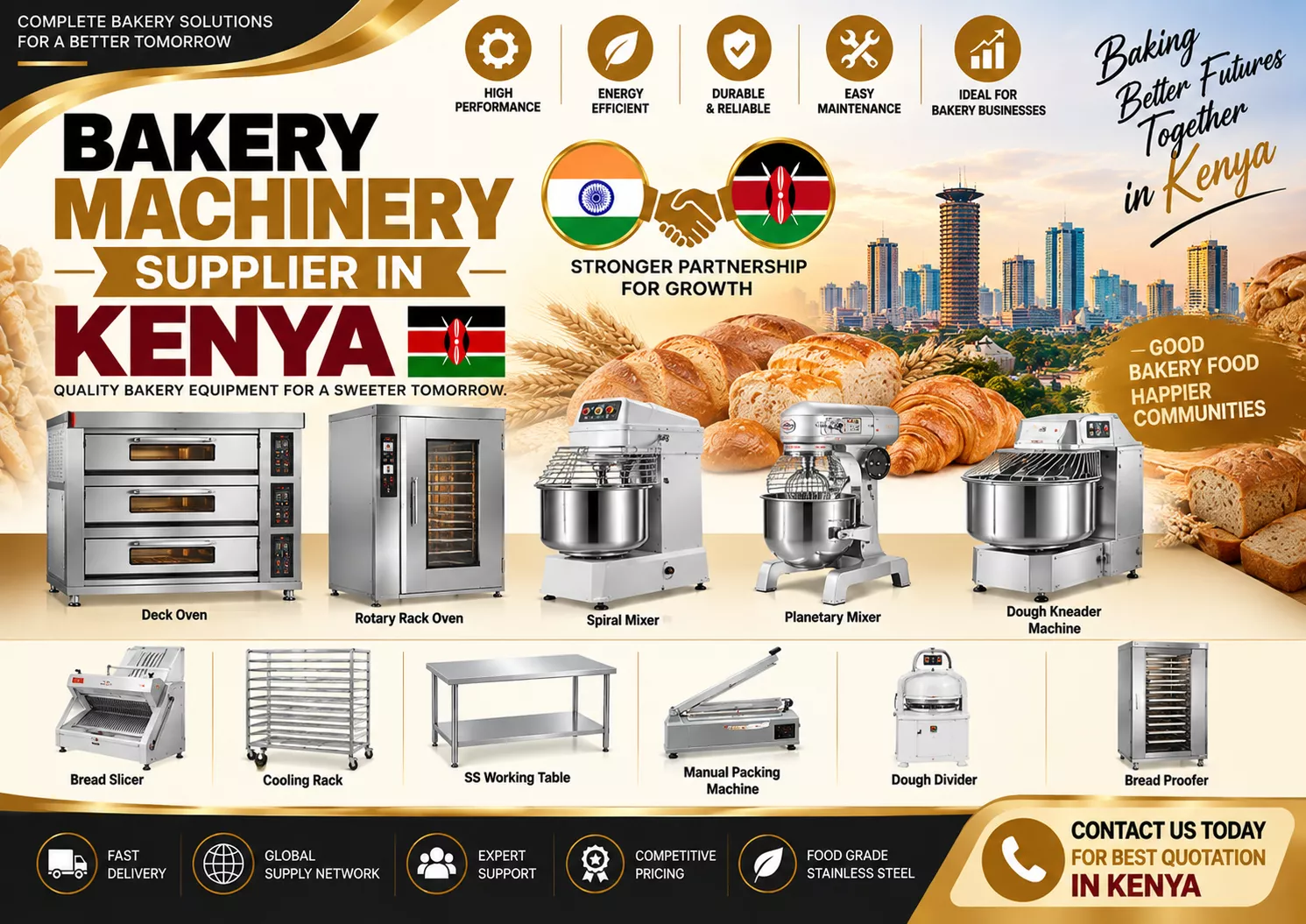
Bakery Machinery Supplier In Kenya
Bakery Machinery Supplier In Kenya provides the equipment required to prepare, process, bake, cool, slice, decorate, and present bakery products on a commercial scale. A modern bakery may need only a few machines for a small production setup, while a large bakery can require a complete production line with dough preparation, forming, proofing, baking, cooling, slicing, and packing equipment.
The right machinery depends on the products you want to make, your expected daily production, available working space, energy supply, labour requirements, and future expansion plans. Bread, cakes, biscuits, cookies, buns, pastries, pizza bases, doughnuts, and other bakery products do not always require the same machines.
For this reason, machinery should be selected according to the actual production process instead of buying equipment simply because it is popular or inexpensive.
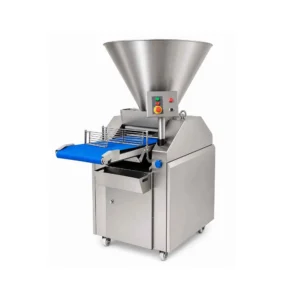
Dough Divider Machine
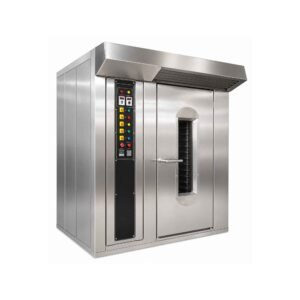
88 Tray Rotary Rack Oven
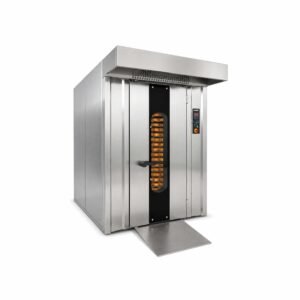
24 Tray Rotary Rack Oven
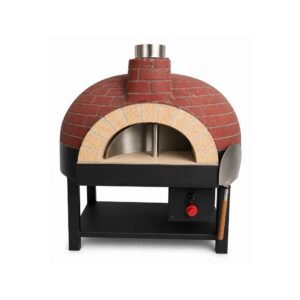
Brick Pizza Oven
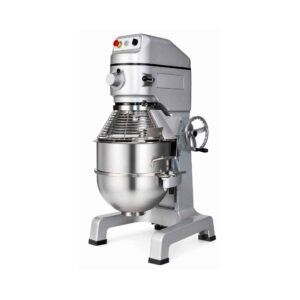
Planetary Mixer 60 Litre
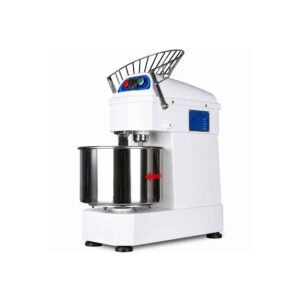
Spiral Mixer 50 Kg
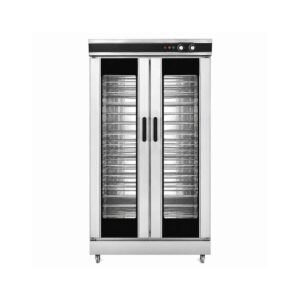
Double Door Dough Proofer
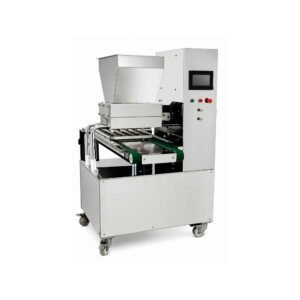
Electric Twin Cake Depositor
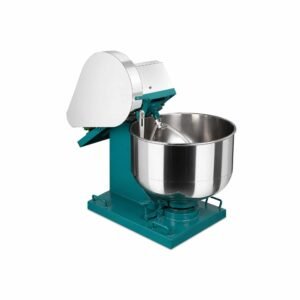
Dough Kneader Machine 20 Kg
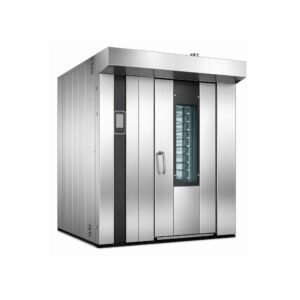
172 Tray Rotary Rack Oven
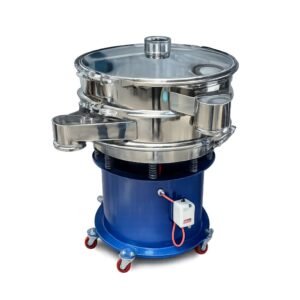
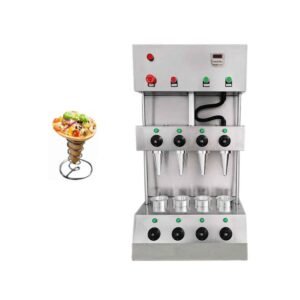
Fully Automatic Pizza Cone Machine
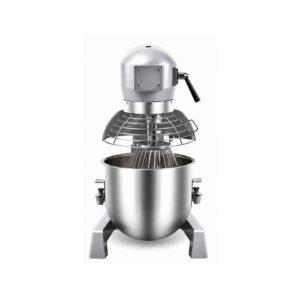
Planetary Mixer 20 Litre
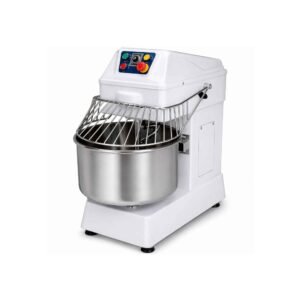
Spiral Mixer 20 Kg
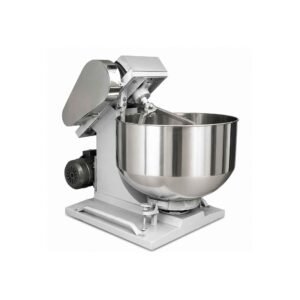
Commercial Dough Kneader Machine 30 Kg
Planning a Bakery Before Buying Machinery
A Bakery Machinery Supplier In Kenya can first help a business understand what equipment is required for its planned production. The first step is to identify the products that will be manufactured.
A bread-focused bakery may need a dough mixer, divider, moulding equipment, proofer, oven, cooling system, and bread slicer. A cake bakery may require planetary mixers, ovens, worktables, cooling racks, decorating equipment, and refrigeration. A pastry business may need a sheeter, planetary mixer, proofing equipment, and suitable baking ovens.
Production volume is another important factor. A small shop producing a limited number of products each day does not necessarily need a large industrial line. Buying oversized equipment can increase the initial investment, electricity consumption, floor-space requirement, and maintenance burden.
On the other hand, equipment that is too small can create production bottlenecks when customer orders increase.
A practical bakery plan therefore begins with three questions:
- What products will be produced?
- How many products are expected each day?
- How much future growth is expected?
The answers help determine the machine capacities and production sequence.
Contact Sri Brothers Enterprises today to discuss your Bakery Machinery requirement and request a quotation.
Planning a Bakery Before Buying Machinery
A Bakery Machinery Supplier In Kenya can first help a business understand what equipment is required for its planned production. The first step is to identify the products that will be manufactured.
A bread-focused bakery may need a dough mixer, divider, moulding equipment, proofer, oven, cooling system, and bread slicer. A cake bakery may require planetary mixers, ovens, worktables, cooling racks, decorating equipment, and refrigeration. A pastry business may need a sheeter, planetary mixer, proofing equipment, and suitable baking ovens.
Production volume is another important factor. A small shop producing a limited number of products each day does not necessarily need a large industrial line. Buying oversized equipment can increase the initial investment, electricity consumption, floor-space requirement, and maintenance burden.
On the other hand, equipment that is too small can create production bottlenecks when customer orders increase.
A practical bakery plan therefore begins with three questions:
- What products will be produced?
- How many products are expected each day?
- How much future growth is expected?
The answers help determine the machine capacities and production sequence.
Bread Production Machinery
For businesses working with bread, a Bakery Machinery Supplier In Kenya can provide individual machines or equipment combinations according to the planned production process.
Bread production normally involves several stages rather than one machine.
The process can begin with ingredient weighing and mixing. Dough is then divided into suitable portions, shaped, proofed, and baked. After baking, loaves may be cooled, sliced, packed, and prepared for distribution.
Typical bread-production machinery can include:
Spiral Dough Mixer: Used for mixing flour, water, yeast, salt, fat, and other ingredients into dough.
Dough Divider: Separates bulk dough into portions of similar weight.
Dough Moulder: Shapes portions into a suitable form before proofing.
Bread Proofer: Provides controlled conditions for dough fermentation and rising.
Bakery Oven: Bakes the dough to the required colour, texture, and internal structure.
Cooling Equipment: Allows freshly baked bread to release heat before slicing and packaging.
Bread Slicer: Cuts loaves into consistent slices for retail sale.
Not every bakery requires all of these machines from the beginning. The equipment list should match the planned production method.
Cake Production Equipment
A cake bakery has different equipment requirements from a bread bakery. A Bakery Machinery Supplier In Kenya can recommend equipment according to the cake varieties, batch sizes, and expected daily output.
Planetary mixers are commonly used for cake batter, cream, eggs, fillings, and other mixtures because they can handle different mixing tasks with interchangeable tools.
A cake-production setup may include:
- Planetary mixer
- Cake oven
- Worktable
- Cooling racks
- Cake decorating tools
- Refrigeration
- Display counter
- Packaging equipment
The oven should be selected according to cake size, tray format, production volume, and available energy source.
For a small cake business, a compact commercial oven may be sufficient. A growing production unit may need a larger convection or rack oven to increase batch capacity.
The objective should be consistent baking rather than simply choosing the oven with the largest tray capacity.
Pastry Production Machinery
Pastry production requires careful dough handling. When discussing pastry equipment with a Bakery Machinery Supplier In Kenya, businesses should explain the products they intend to produce.
Products such as puff pastry, croissants, Danish pastries, pies, and other laminated products may require dough sheeting and controlled folding.
A pastry sheeter can reduce manual rolling and help produce more consistent dough thickness. This can be particularly useful when production volume increases.
Depending on the product range, pastry production may require:
- Planetary or spiral mixer
- Dough sheeter
- Worktable
- Dough cutter
- Proofing cabinet
- Baking oven
- Cooling racks
- Refrigeration
The correct machine combination depends on whether the bakery produces fresh pastry daily or operates a larger wholesale production model.
Choosing Between Spiral and Planetary Mixers
Mixer selection is one of the most important decisions for a bakery.
A spiral mixer is primarily designed for dough preparation. It is widely used for bread, pizza dough, buns, rolls, and similar products.
A planetary mixer is more versatile for products such as cake batter, cream, eggs, icing, fillings, and lighter mixtures.
A bakery producing both bread and cakes may need both types.
Trying to use one mixer for every product can create limitations. The mixer should be selected according to the ingredients, dough consistency, batch size, and production frequency.
The bowl capacity alone should not determine the purchase. Motor power, mixing tools, speed settings, construction, controls, and actual working capacity also matter.
Selecting the Right Bakery Oven
The oven is the centre of many bakery production systems. A Bakery Machinery Supplier In Kenya can help compare different oven configurations according to product type and production requirements.
Different ovens produce different results and support different production methods.
Deck Oven
Deck ovens are commonly considered for bread, pizza, pastries, cakes, and products where controlled baking conditions are important.
Different decks can allow separate batches to be managed during production.
Convection Oven
Convection ovens use circulating hot air to support more uniform baking. They are often suitable for cakes, pastries, cookies, and other products where consistent airflow is useful.
Rotary Rack Oven
A rotary rack oven is designed for higher-volume production. A complete rack can be loaded with multiple trays and placed inside the baking chamber.
This can reduce manual tray handling and support larger batch production.
Tunnel Oven
Tunnel ovens are generally associated with continuous industrial production. Products move through the baking chamber on a conveyor while controlled baking conditions are maintained.
They are more suitable for large-scale production than a small retail bakery.
The best oven depends on production volume, product type, available space, energy source, and desired automation level.
Proofing Is Part of Production Quality
Proofing is not simply waiting for dough to rise.
Temperature and humidity can influence fermentation and dough development. Changes in the surrounding environment can therefore affect the final product.
A commercial proofer creates a more controlled environment for dough before baking.
This can help bakeries produce more consistent results across different batches.
Proofers are especially useful when production increases because relying entirely on room conditions can make production timing harder to control.
A Bakery Machinery Supplier In Kenya should therefore consider proofing equipment as part of the complete production process rather than treating it as an optional accessory.
Dough Dividing and Moulding
Manual dough division can become difficult when production volume grows.
Workers may divide dough by hand, but differences in portion weight can affect the final loaf size and selling consistency.
A dough divider can help create portions with more uniform weight.
A dough moulder can then shape those portions according to the required product.
These machines become particularly useful when the bakery supplies supermarkets, restaurants, institutions, hotels, or multiple retail outlets.
The investment should be matched to production volume. A small bakery may manage initial production manually and introduce automation when labour requirements increase.
Cookies and Biscuit Production
Cookies and biscuits require their own production considerations. A Bakery Machinery Supplier In Kenya can help select machinery according to the recipe, dough characteristics, product shape, and expected output.
Depending on the product, a commercial bakery may require:
- Planetary or continuous mixer
- Dough preparation equipment
- Sheeting equipment
- Rotary cutter
- Depositor
- Baking oven
- Cooling conveyor
- Packaging machine
For industrial biscuit production, continuous systems can be used to create a more automated workflow.
Small and medium bakeries may use simpler equipment and produce products in batches.
The key is to select machinery that matches the planned product range instead of purchasing an industrial line for a business that has not yet developed enough demand.
Equipment for Doughnuts and Fried Bakery Products
Not every bakery product is baked in an oven.
Doughnuts, mandazi, and other fried bakery products require frying equipment in addition to dough preparation machinery.
A suitable production setup may include:
- Dough mixer
- Dough divider or depositor
- Doughnut cutter or former
- Fryer
- Oil filtration system
- Cooling area
- Glazing or finishing station
- Packaging equipment
Temperature control is important in frying because inconsistent conditions can affect colour, texture, cooking time, and oil absorption.
The production area should also be designed for safe handling of hot oil and easy cleaning.
Production Efficiency and Machine Layout
Production efficiency does not always mean adding more automation. A Bakery Machinery Supplier In Kenya can also help businesses consider the physical arrangement of equipment.
Sometimes a better machine layout can save more time than purchasing an expensive machine.
For example, if the mixer is positioned far from the preparation table, employees may spend unnecessary time moving heavy dough. If the proofer is placed far from the oven, tray movement becomes inefficient.
A practical bakery layout should follow the product journey.
A simple flow can be:
Ingredient Storage → Mixing → Dividing → Shaping → Proofing → Baking → Cooling → Slicing → Packaging → Dispatch
Keeping this sequence logical can reduce unnecessary movement and improve workflow.
For larger projects, suppliers may provide layout and turnkey planning services covering equipment selection, installation, commissioning, and staff training.
Machinery for Small Bakeries
A startup bakery normally has different requirements from an industrial bakery. A Bakery Machinery Supplier In Kenya can help a new business build a basic machine list without immediately investing in a complete industrial line.
A small setup may begin with:
- Commercial mixer
- Small or medium oven
- Proofer
- Baking trays
- Worktables
- Cooling racks
- Refrigerator
- Basic packaging equipment
As sales increase, the bakery can add:
- Larger mixer
- Dough divider
- Dough moulder
- Larger proofer
- Rack oven
- Bread slicer
- Packaging machine
- Additional refrigeration
This staged approach can help a business match machinery investment with actual production requirements.
Machinery for Medium-Sized Bakeries
A medium-sized bakery may serve retail shops, supermarkets, restaurants, schools, hotels, or wholesale customers.
At this stage, production consistency becomes more important because a delay in one department can affect the entire day’s schedule.
A medium bakery may require dedicated machines for mixing, dividing, moulding, proofing, baking, cooling, slicing, and packaging.
Commercial bakery equipment can include deck ovens, convection ovens, rotary ovens, spiral mixers, planetary mixers, dividers, sheeters, proofers, and bread slicers.
The exact equipment list should still be based on the bakery’s product mix and production target.
Industrial Bakery Machinery
Industrial bakeries operate at a much larger scale. For such projects, a Bakery Machinery Supplier In Kenya may be involved in planning an integrated production line rather than supplying only individual machines.
Their equipment may include automated ingredient handling, continuous mixing, dough processing, forming, proofing, industrial baking, cooling conveyors, slicing, packaging, and product inspection.
Industrial bakery systems can also be designed for specific products such as bread, cookies, crackers, biscuits, snacks, and other baked goods.
At this scale, machine integration becomes important.
A faster oven does not necessarily increase total output if the mixer, proofer, cooling system, or packaging machine cannot handle the same volume.
The complete production line should therefore be balanced around the required output.
Energy Requirements in Kenya
Energy planning should be considered before purchasing bakery equipment. A professional Bakery Machinery Supplier In Kenya should be given information about the available power supply before final equipment selection.
Ovens, mixers, proofers, refrigeration units, and packaging machines may have different power requirements.
Before installation, confirm:
- Available electrical supply
- Voltage
- Phase requirement
- Connected load
- Gas availability where applicable
- Ventilation requirements
- Backup power requirements
- Space for electrical panels
- Heat extraction requirements
An oven that appears affordable can become expensive to operate if its energy requirements do not match the bakery’s production plan.
Energy-efficient equipment can be particularly important for businesses operating ovens and refrigeration equipment for long production hours.
Hygiene and Food-Safe Construction
Bakery equipment should support regular cleaning and hygienic production.
Food-contact surfaces should be suitable for their intended application. The machine design should also avoid unnecessary gaps where flour, dough, grease, or food particles can accumulate.
Important areas include:
- Mixing bowls
- Dough-contact surfaces
- Baking trays
- Worktables
- Product conveyors
- Cooling areas
- Slicing equipment
- Packaging zones
A clean production environment protects product quality and makes routine operations easier.
Installation and Operator Training
Buying a machine is only one part of a bakery project. A Bakery Machinery Supplier In Kenya may also support installation, commissioning, and operator training depending on the project.
Correct installation is important because equipment must be connected, positioned, levelled, tested, and commissioned correctly.
Operators should also understand:
- Machine controls
- Safe operating procedures
- Cleaning requirements
- Daily checks
- Emergency stopping
- Basic troubleshooting
- Maintenance schedules
Training is particularly important when several machines are connected into one production workflow.
Spare Parts and After-Sales Support
A bakery cannot afford unnecessary production downtime.
If an oven, mixer, proofer, or slicer stops working during a busy production period, the effect can extend beyond one machine.
When evaluating a Bakery Machinery Supplier In Kenya, ask about:
- Spare parts availability
- Technician support
- Warranty
- Preventive maintenance
- Emergency repair
- Replacement components
- Installation support
- Operator training
After-sales service should be considered part of the machine investment.
Comparing Bakery Machinery Suppliers
Price is only one part of supplier comparison. A Bakery Machinery Supplier In Kenya should be evaluated on the complete value of the equipment and service package.
Two machines may have similar external dimensions but different motors, controls, materials, insulation, heating systems, production capacities, and maintenance requirements.
Before making a purchase, compare:
Machine capacity: Check actual working capacity instead of only the advertised bowl or tray size.
Construction: Check the materials used in food-contact and structural areas.
Controls: Understand whether operation is manual, semi-automatic, or automatic.
Energy consumption: Compare the expected operating requirement.
Installation: Confirm whether installation is included.
Training: Ask whether operators receive machine training.
Warranty: Understand what components are covered and for how long.
Spare parts: Confirm availability of commonly replaced components.
Service: Ask how technical support will be handled after installation.
Expansion: Consider whether the supplier can support future production upgrades.
Creating a Complete Bakery Equipment List
Before requesting a quotation, prepare a machine list based on the products you want to manufacture.
For a bread bakery, the list may include:
- Spiral dough mixer
- Dough divider
- Dough moulder
- Proofer
- Bakery oven
- Cooling racks
- Bread slicer
- Packaging equipment
For a cake and pastry bakery, the list may include:
- Planetary mixer
- Convection or deck oven
- Dough sheeter
- Proofer
- Refrigeration
- Worktables
- Cooling racks
- Cake decorating equipment
- Display counter
For a larger bakery, these systems can be combined with automated production and packaging equipment.
Preparing the list first makes supplier discussions clearer and reduces the chance of missing an important production stage.
What to Send When Requesting a Quotation
A detailed inquiry helps a Bakery Machinery Supplier In Kenya recommend more suitable equipment.
Include:
- Bakery type
- Products to be manufactured
- Target production per day
- Required machine capacities
- Available floor space
- Electrical supply
- Gas availability
- Number of workers
- Required automation level
- Delivery location
- Installation requirement
- Training requirement
- Future expansion plans
If possible, provide a floor plan or measurements of the production area.
This allows the supplier to consider machine dimensions and workflow before recommending equipment.
Building a Bakery That Can Grow
A bakery should not be planned only around today’s production.
Customer demand can increase after the business develops relationships with supermarkets, hotels, restaurants, schools, distributors, and retail shops.
Future expansion may require additional ovens, larger mixers, automated forming equipment, packaging machines, refrigeration, or storage.
Leaving suitable space for future equipment can make expansion easier.
It is also useful to select machines from suppliers that can continue supporting the bakery as its production requirements change.
Frequently Asked Questions
The requirement depends on the products and production volume. Common machines include dough mixers, ovens, proofers, dough dividers, moulders, sheeters, bread slicers, planetary mixers, cooling equipment, and packaging machines.
A spiral mixer is generally designed for bread and other heavy dough applications. The correct size depends on batch quantity and production frequency.
Planetary mixers are commonly used for cake batter, cream, eggs, icing, and other lighter mixtures. The required bowl size depends on production volume.
A commercial deck or convection oven may be suitable depending on the products and expected output. The decision should be based on tray capacity, energy supply, product type, and available space.
A commercial proofer can provide more controlled proofing conditions and help improve production consistency, especially when bakery output increases.
Yes. Bakery projects can be planned around specific production volumes, product types, available space, energy requirements, and automation levels.
Check capacity, construction, energy requirements, controls, installation, warranty, spare parts, technical support, maintenance, and operator training.
Some suppliers provide multiple bakery machines and turnkey project services, including equipment supply, layout, installation, commissioning, and training.
Not always. A startup should first calculate expected production and select equipment that matches its current business model while leaving room for practical expansion.
Final Thoughts
Selecting a Bakery Machinery Supplier In Kenya is not simply about finding individual machines. It is about creating a production system in which every stage works together.
The mixer should match the dough requirement. The divider should match the production speed. The proofer should support the required fermentation process. The oven should handle the planned batch size. Cooling, slicing, and packaging should not become bottlenecks after baking.
A small bakery may begin with essential equipment, while a growing operation can gradually introduce automation and higher-capacity machinery.
Before placing an order, clearly define your products, daily production target, available space, energy supply, budget, and future expansion plans. Then compare machinery based on capacity, construction, operating requirements, installation, maintenance, spare parts, and technical support.
With the right production plan, bakery machinery can help create a more organized workflow, consistent products, and a stronger foundation for commercial bakery growth in Kenya.

Add a review
Your email address will not be published. Required fields are marked *