
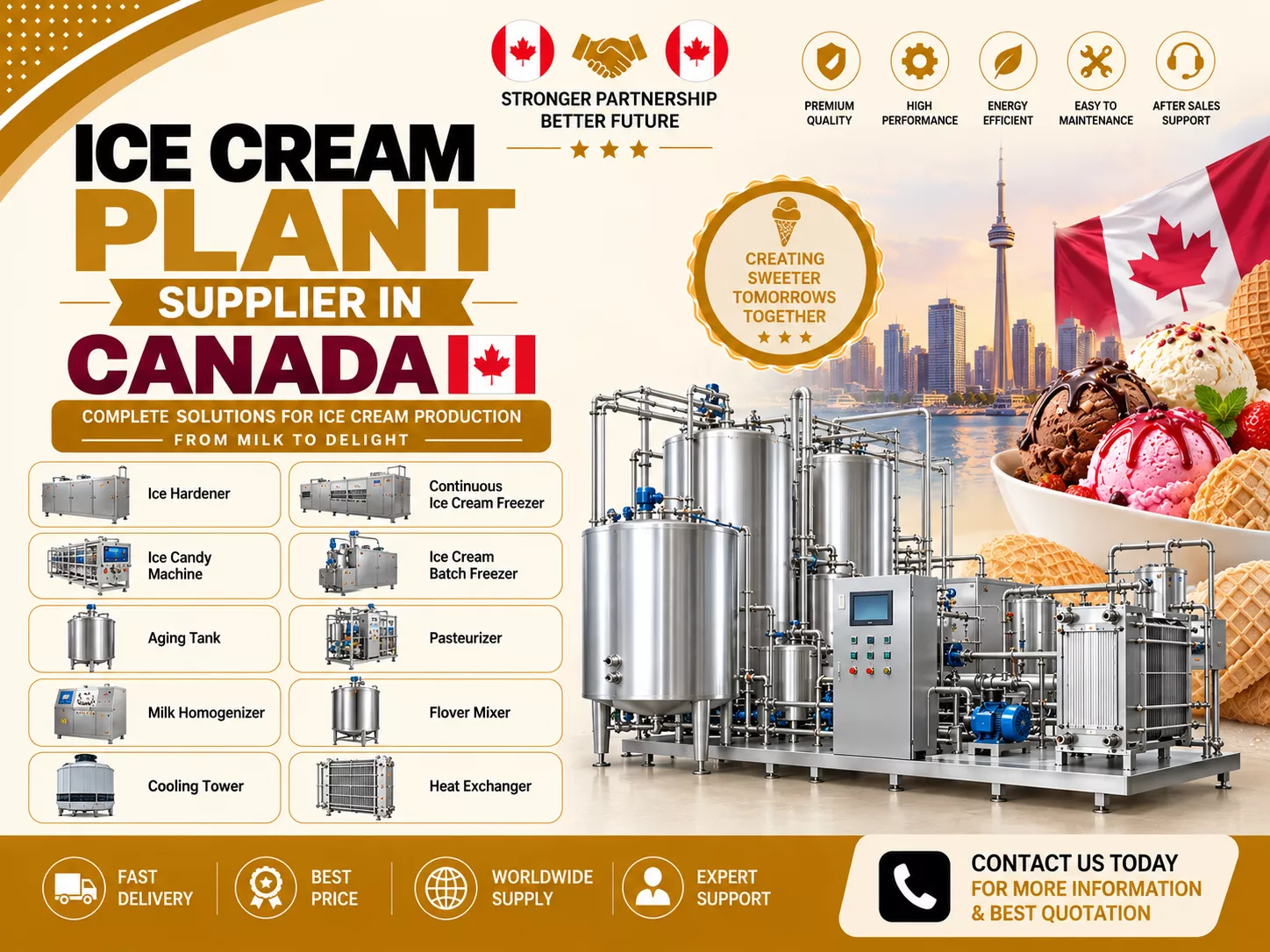
Ice Cream Plant Supplier in Canada
Complete Guide to Ice Cream Production Equipment
Choosing the right Ice Cream Plant Supplier in Canada is an important decision for dairy manufacturers, ice cream brands, dessert companies, food-processing businesses, and entrepreneurs planning to establish or expand an ice cream production facility. An ice cream plant is not a single machine; it is a coordinated processing system in which mixing, pasteurization, homogenization, cooling, ageing, freezing, filling, hardening, storage, and packaging can work together to produce a consistent finished product.
For a new project, the most important question is not simply “Which ice cream machine should I buy?” Instead, the buyer should determine the required production capacity, product range, level of automation, processing method, available utilities, plant layout, hygiene requirements, and future expansion plans.
This is why selecting an Ice Cream Plant Supplier in Canada should involve both equipment evaluation and process planning.
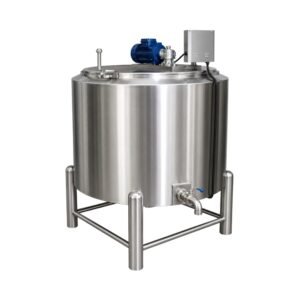
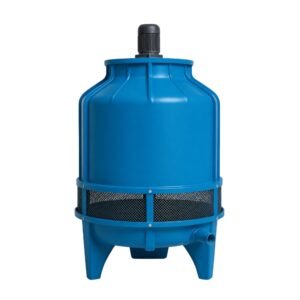
What Is an Ice Cream Plant?
An industrial ice cream plant is a collection of processing and production equipment designed to manufacture ice cream or other frozen desserts at commercial scale.
Depending on the production requirement, a complete plant can include:
- Mix preparation system
- Mixing tanks
- Pasteurizer
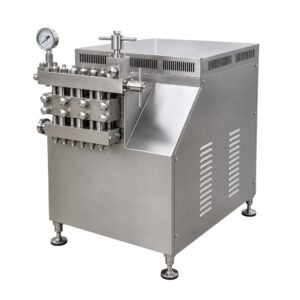
- Homogenizer
- Plate heat exchanger or chiller
- Ageing tanks
- Transfer pumps
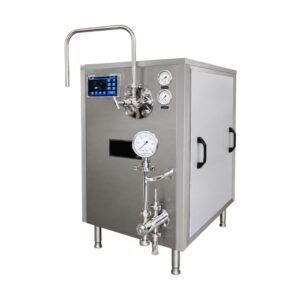
- Continuous or batch freezer
- Flavour and ingredient systems
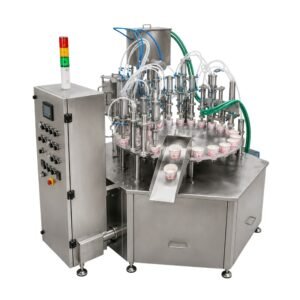
- Filling machine
- Hardening system or tunnel
- Cold storage
- Refrigeration system
- Cleaning and sanitation equipment
- Utilities and control systems
Canadian food-innovation facilities demonstrate this complete-process approach. The University of Guelph’s Food Innovation Centre, for example, lists pasteurization, homogenization, batch and continuous freezing, jacketed mixing tanks, hardening, ripple pumping and inclusion feeding among its ice-cream processing capabilities.
A professional Ice Cream Plant Supplier in Canada should therefore understand the relationship between individual machines instead of treating every piece of equipment as an independent purchase.
Contact Sri Brothers Enterprises today to discuss your Ice Cream Plant requirement and request a quotation.
How Does an Industrial Ice Cream Plant Work?
The exact process varies according to the recipe and production system, but a typical industrial workflow can be represented as:
Ingredient Preparation → Mixing → Pasteurization → Homogenization → Cooling → Ageing → Freezing → Filling → Hardening → Packaging → Frozen Storage
Each stage has a different purpose.
- Mix Preparation
Milk, cream, sugar, milk solids, stabilizers, emulsifiers, flavour ingredients, and other recipe components are combined according to the formulation.
Proper dispersion is important because poorly dispersed ingredients can create inconsistencies later in the process.
- Pasteurization
The prepared mix is heat-treated according to the applicable process requirements. In commercial ice-cream production, pasteurization is an important food-safety and process-control stage.
- Homogenization
Homogenization reduces the size of fat globules and helps create a more uniform emulsion. This can contribute to the desired texture and stability of the finished product.
- Cooling
After heat treatment, the mix is cooled before the next processing stage.
- Ageing
The cooled mix may be held under controlled conditions to allow ingredients to hydrate and the mix to develop suitable physical properties before freezing.
- Freezing
The ice-cream mix enters a batch or continuous freezer where it is partially frozen and air is incorporated according to the desired product characteristics.
- Filling and Packaging
The frozen product can then be filled into cups, tubs, cones, containers, or other packaging formats.
- Hardening
Packaged products may pass through a hardening system or tunnel to rapidly reduce product temperature and stabilize the frozen structure.
This integrated process is why a Ice Cream Plant Supplier in Canada needs to consider the entire production line when planning a commercial project.
Why Is Process Integration Important?
Buying individual machines without considering the complete production process can create problems.
For example, a freezer may have a higher theoretical capacity than the upstream mix-preparation system. In that situation, the freezer cannot necessarily achieve its full potential because it does not receive enough properly prepared mix.
Similarly, a filling machine may have a higher nominal output than the hardening or packaging system downstream.
A properly designed plant should therefore balance:
Mix Preparation → Thermal Processing → Homogenization → Ageing → Freezing → Filling → Hardening → Packaging
The objective is to create a production flow where the major stages work together rather than creating bottlenecks.
Tetra Pak Canada, for example, describes its processing portfolio as integrated solutions for dairy and ice cream applications and emphasizes matching technology to application and capacity requirements.
What Production Capacity Do You Need?
Production capacity is one of the first things a buyer should define before contacting an Ice Cream Plant Supplier in Canada.
Capacity may be expressed in different ways depending on the equipment:
- Litres per hour
- Litres per batch
- Kilograms per hour
- Kilograms per batch
- Containers per minute
- Containers per hour
These figures should not be confused.
For example, a mix-preparation unit may be rated in litres per hour, while a batch freezer may be specified by batch volume or production per cycle.
Tetra Pak Canada’s ice-cream mix-unit range, for example, includes models specified at capacities from hundreds to several thousand litres per hour.
The correct capacity should be determined from the production target rather than selecting the largest available machine.
How to Calculate Ice Cream Plant Capacity
A simple production-planning approach starts with your required daily output.
For example, if your business wants to produce 5,000 litres of ice cream per day, you need to consider:
- Number of production hours
- Mix preparation capacity
- Pasteurization capacity
- Homogenizer capacity
- Ageing capacity
- Freezing capacity
- Filling speed
- Hardening capacity
- Packaging speed
- Cleaning and changeover time
If production is planned over eight operating hours, the theoretical average requirement would be:
5,000 L ÷ 8 hours = 625 L/hour
However, this does not mean that every machine should simply be rated at 625 L/hour. Production downtime, cleaning, recipe changes, maintenance, filling variations, and process losses need to be considered.
A knowledgeable Ice Cream Plant Supplier in Canada should help translate the desired daily production into appropriate equipment capacities.
Small, Medium and Large Ice Cream Plants
The appropriate plant configuration depends heavily on the business model.
Small Ice Cream Production Plant
A smaller plant may be appropriate for:
- Artisan ice cream producers
- Local dessert brands
- Small dairy businesses
- Restaurants with in-house production
- Pilot commercial production
Compact batch equipment can be useful where product variety is more important than continuous high-volume production.
For example, Canadian equipment suppliers offer compact batch-freezing equipment for cafés, restaurants and dessert operations, including machines intended for small-batch ice cream and gelato production.
Medium-Capacity Ice Cream Plant
A medium-scale facility may produce multiple flavours and packaging formats while supplying several retail locations or foodservice customers.
Such a plant may require:
- Larger mix tanks
- Batch or continuous pasteurization
- Homogenizer
- Ageing vats
- Freezer
- Filling system
- Hardening equipment
- Cold storage
Automation can be increased as production volume grows.
Large Industrial Ice Cream Plant
A large manufacturer may need a highly integrated automated system with:
- Large-capacity mix preparation
- Continuous pasteurization
- High-capacity homogenization
- Multiple ageing tanks
- Continuous freezing
- Ingredient dosing
- Automated filling
- Hardening tunnel
- Packaging
- Refrigerated storage
- CIP systems
- Centralized controls
At this level, equipment layout and process engineering become just as important as individual machine specifications.
Batch Freezer vs Continuous Freezer
The freezer is one of the most important pieces of equipment in an ice cream plant.
Batch Freezer
A batch freezer processes a defined quantity of mix during each cycle.
It can be useful for:
- Artisan products
- Multiple flavours
- Smaller production volumes
- Specialty recipes
- Product development
The batch approach can provide flexibility when production involves frequent flavour changes.
Continuous Freezer
A continuous freezer is designed for ongoing production and can be more suitable for high-volume manufacturing.
It can support:
- Larger production volumes
- Continuous processing
- Consistent product output
- Integration with automatic filling systems
Tetra Pak Canada describes ice-cream freezing equipment for a wide range of applications, including premium ice cream, low-fat frozen desserts, moulded products, extruded products and filled products.
The choice between batch and continuous freezing should be based on production volume, product type, recipe requirements and the overall line design.
Pasteurizer Selection for an Ice Cream Plant
Pasteurization is a critical processing stage.
A commercial ice cream plant may use batch or continuous/HTST pasteurization depending on production requirements.
Batch Pasteurizer
A batch system can provide flexibility for smaller production volumes and varied recipes.
HTST Pasteurizer
High-temperature-short-time systems can be appropriate for larger continuous operations where high throughput and controlled processing are required.
The University of Guelph’s pilot ice-cream facility lists both HTST and batch pasteurization capabilities, illustrating how different processing approaches can be used according to scale and application.
When evaluating an Ice Cream Plant Supplier in Canada, ask the supplier to explain which pasteurization configuration is appropriate for your planned production.
Why Is a Homogenizer Important?
Homogenization is another important stage in ice cream mix processing.
The process reduces fat-globule size and helps distribute the fat phase more uniformly throughout the mix. This contributes to the physical characteristics of the product and can support a smoother, more consistent texture.
The University of Guelph’s ice-cream processing facility includes a commercial-scale two-stage homogenizer, while industrial ice-cream plant designs commonly place homogenization after pasteurization and before cooling/ageing.
The appropriate homogenizer pressure, configuration, flow rate and number of stages depend on the formulation and plant capacity.
Ageing Tank for Ice Cream Production
After pasteurization, homogenization and cooling, the mix may be transferred to ageing tanks.
Ageing allows the mix components to interact and hydrate under controlled conditions before freezing.
A commercial plant may use multiple ageing tanks depending on:
- Production capacity
- Number of recipes
- Batch size
- Ageing time
- Production schedule
- Cleaning requirements
For a high-volume plant, multiple tanks can also provide production flexibility by allowing different batches to be at different stages of the process.
Mixing System and Ingredient Dispersion
Good ice cream begins with properly prepared mix.
Ingredients such as sugar, milk powder, stabilizers and emulsifiers need to be incorporated appropriately into the liquid phase.
Mixing equipment may include:
- Jacketed mixing tanks
- High-shear mixers
- Powder induction systems
- Ingredient dosing equipment
- Agitators
- Transfer pumps
The University of Guelph’s ice-cream facility, for example, uses jacketed mixing tanks with a total capacity of 1,200 litres for its pilot-scale processing activities.
The appropriate mixing configuration depends on the formulation and production scale.
Ice Cream Filling Machine
Once the product has been frozen, it must be transferred into its final packaging.
Filling equipment can be designed for formats such as:
- Cups
- Tubs
- Containers
- Cones
- Bulk packs
The filling system should be compatible with the freezer output and packaging format.
If the freezer produces product faster than the filler can package it, the filling stage can become a bottleneck. Conversely, an oversized filler can be inefficient if upstream production is significantly lower.
This is why a complete Ice Cream Plant Supplier in Canada should consider production balance throughout the line.
Hardening System
After filling, packaged ice cream may require rapid hardening.
Hardening helps reduce the temperature of the product and stabilize its frozen structure.
A hardening system can be designed as:
- Hardening room
- Blast freezer
- Hardening tunnel
- Spiral hardener
- Other refrigeration-based systems
The University of Guelph’s Food Innovation Centre lists a hardening room operating around -30°C as part of its ice-cream processing capabilities.
Large industrial manufacturers may instead use continuous hardening tunnels when higher production throughput is required.
Cold Storage and Refrigeration
Finished ice cream must remain frozen throughout storage and distribution.
An industrial plant therefore needs appropriate:
- Cold storage
- Refrigeration system
- Temperature monitoring
- Product handling
- Loading and unloading arrangements
Cold-chain planning should begin during plant design rather than being treated as an additional facility requirement after the processing equipment has been selected.
Automation in an Ice Cream Plant
Automation can improve process repeatability and reduce manual intervention.
Depending on the plant size, automation may control:
- Ingredient dosing
- Temperature
- Mixing
- Pasteurization
- Homogenization
- Transfer
- Freezing
- Filling
- Cleaning
- Alarm systems
- Production data
However, full automation is not always the best option for every business.
A smaller producer may benefit from semi-automatic equipment because it provides flexibility and a lower level of system complexity.
A large manufacturer producing continuously may justify a more automated PLC-controlled system.
The right Ice Cream Plant Supplier in Canada should therefore recommend automation according to production requirements rather than presenting automation as an automatic upgrade.
Food Hygiene and Sanitation
Hygiene is fundamental to dairy and frozen-dessert production.
Equipment should be designed so that product-contact areas can be cleaned and sanitized appropriately. The plant should also have a documented cleaning and sanitation process consistent with applicable food-safety requirements.
Important considerations include:
- Food-contact materials
- Weld quality
- Accessible surfaces
- Hygienic piping
- Drainage
- Cleaning access
- Sanitation procedures
- CIP compatibility where applicable
Canadian food-production projects should also account for applicable federal, provincial, municipal and facility-specific requirements.
The University of Guelph specifically identifies CIP and sanitation systems as part of its dairy-grade pilot-scale capabilities.
Stainless Steel Construction
Stainless steel is widely used in commercial dairy and food-processing equipment because it can provide durability and suitable hygienic surfaces when properly designed and maintained.
Depending on the equipment, different grades may be specified for different applications.
Buyers should request the exact material specification instead of assuming that every stainless-steel component has the same grade.
For food-contact equipment, the material, surface finish, weld quality and hygienic design should all be evaluated.
Electrical and Utility Requirements
An industrial ice cream plant can require multiple utilities.
Depending on the equipment configuration, these may include:
- Electrical power
- Refrigeration
- Chilled water
- Hot water or steam
- Compressed air
- Process water
- Drainage
- Ventilation
- Cleaning utilities
The exact requirement depends on the plant capacity and equipment configuration.
Before ordering from an Ice Cream Plant Supplier in Canada, obtain a utility-load summary and site-preparation requirements for the proposed plant.
This can prevent costly modifications after equipment delivery.
How to Choose an Ice Cream Plant Supplier in Canada
Choosing the supplier should be approached with the same care as selecting the equipment.
A reliable supplier should be able to discuss the complete production process.
Technical Expertise
The supplier should understand how mixing, pasteurization, homogenization, ageing and freezing interact.
Project Experience
Ask whether the supplier has experience with commercial or industrial food-processing projects comparable to yours.
Complete Documentation
Request:
- Equipment specifications
- Process flow
- Utility requirements
- Plant layout
- Installation information
- Operation manuals
- Maintenance documentation
- Warranty terms
After-Sales Support
A production plant requires ongoing technical support.
Ask about:
- Installation
- Commissioning
- Operator training
- Spare parts
- Preventive maintenance
- Troubleshooting
- Remote technical support
- On-site service
Transparent Specifications
A trustworthy supplier should clearly distinguish between theoretical capacity and recommended operating capacity.
This transparency is an important part of making a responsible purchasing decision.
How Much Does an Ice Cream Plant Cost in Canada?
There is no single price for an ice cream plant because a complete plant is engineered around production capacity and product requirements.
The investment can vary according to:
- Production capacity
- Level of automation
- Batch or continuous processing
- Number of ageing tanks
- Homogenizer configuration
- Freezer capacity
- Filling system
- Hardening system
- Refrigeration
- Cold storage
- CIP system
- Plant utilities
- Packaging requirements
- Installation
- Commissioning
- Building modifications
A small artisanal production setup can be fundamentally different from a high-volume industrial plant.
Therefore, when requesting a quotation from an Ice Cream Plant Supplier in Canada, provide a clear project brief instead of asking for a generic plant price.
What Information Should You Give the Supplier?
A detailed project brief can include:
- Target production per day
- Target production per hour
- Product types
- Number of flavours
- Recipe characteristics
- Packaging formats
- Required filling speed
- Required freezer capacity
- Desired automation level
- Available building space
- Electrical supply
- Steam or hot-water availability
- Refrigeration requirements
- Water availability
- Drainage arrangements
- Cold-storage capacity
- Expected future expansion
- Cleaning requirements
- Installation location
- Desired commissioning date
The more accurately these requirements are defined, the easier it becomes for the supplier to design a suitable processing solution.
Common Mistakes When Buying an Ice Cream Plant
Buying Equipment Without a Process Plan
Individual machines should work together as a complete process.
Selecting Capacity Based Only on Daily Output
Peak production and cleaning/changeover time also affect required capacity.
Ignoring Future Growth
A plant designed only for today’s production may become restrictive as sales increase.
Choosing Maximum Automation Without a Business Case
Automation should solve a production problem and fit the available workforce and operating model.
Focusing Only on Equipment Price
Installation, utilities, refrigeration, commissioning, spare parts and maintenance can affect the total project cost.
Not Checking Utility Requirements
Electrical, water, refrigeration, steam, compressed air and drainage requirements should be understood before installation.
Not Asking About After-Sales Support
A production plant is a long-term investment. Technical support and spare parts can be important throughout its operating life.
What Makes a Trustworthy Ice Cream Plant Supplier?
A trustworthy Ice Cream Plant Supplier in Canada should provide more than a catalogue and quotation.
The supplier should demonstrate:
Experience — practical understanding of commercial ice cream production and plant workflows.
Expertise — ability to explain process stages, capacities, utilities, equipment selection and limitations.
Authority — credible technical documentation, identifiable equipment specifications and evidence of relevant industry capability.
Trust — transparent quotations, realistic performance expectations, clear warranty terms, service information and no unsupported guarantees.
For larger projects, buyers should also request references or documented project information where appropriate and verify technical claims before committing to the final design.
Frequently Asked Questions
An Ice Cream Plant Supplier in Canada provides equipment and, depending on the project, engineering or integration services for commercial and industrial ice cream production. A complete solution may include mixing, pasteurization, homogenization, ageing, freezing, filling, hardening, refrigeration and other supporting systems.
A typical plant may require a mix preparation system, pasteurizer, homogenizer, cooling system, ageing tanks, freezer, filling equipment, hardening system, refrigeration and cold storage. The exact configuration depends on the production capacity and product range.
A batch system processes defined quantities at a time and can provide flexibility for smaller or varied production. A continuous system is designed for ongoing high-volume processing and can be integrated with automated production lines.
Homogenization reduces fat-globule size and helps create a more uniform emulsion. It is an important processing step for many commercial ice cream formulations.
Start with your required daily and peak-hour production, then work backward through mixing, pasteurization, homogenization, ageing, freezing, filling and hardening. The plant should be balanced around the required production flow.
Yes. Smaller commercial and artisanal production systems are available. The appropriate plant depends on production volume, product range, available space, investment and desired automation.
The cost depends heavily on capacity, automation, processing equipment, filling format, refrigeration, hardening, utilities, installation and other project requirements. A customized quotation is normally more meaningful than a generic price.
Ask about production capacity, process flow, equipment specifications, utility requirements, automation, installation, commissioning, operator training, warranty, spare parts, maintenance and technical support.
Food-processing equipment commonly uses stainless steel for appropriate product-contact and hygienic applications, but the exact grade and construction should be verified for each component and process.
Yes. A plant can be configured to produce multiple flavours, but product changeover, cleaning, ingredient dosing, storage and filling requirements need to be considered during design.
Expansion can be possible if the initial plant layout, utilities and equipment configuration are designed with future capacity in mind. Discuss expansion plans with the supplier before finalizing the original plant design.
Final Conclusion
Selecting an Ice Cream Plant Supplier in Canada is a major decision for any business planning commercial frozen-dessert production. The right supplier should understand that an ice cream plant is a complete processing system rather than a collection of unrelated machines.
The production journey can involve mix preparation, pasteurization, homogenization, cooling, ageing, freezing, filling, hardening, packaging and cold storage. Each stage needs to be matched with the next so that the complete line can operate efficiently.
For a smaller artisan producer, a compact batch-oriented system may provide the flexibility required for multiple recipes and flavours. A growing commercial manufacturer may need larger preparation and freezing equipment, while a large industrial producer may benefit from continuous processing, automated filling, hardening and integrated controls.
The most important step is to define your production requirement before selecting the equipment. Consider daily production, peak demand, product range, batch size, packaging format, utilities, plant space, automation and future growth.
When evaluating an Ice Cream Plant Supplier in Canada, look beyond the initial quotation. Compare technical expertise, process understanding, equipment documentation, installation, commissioning, warranty, spare-parts availability and long-term technical support.
A supplier that provides clear specifications and realistic production expectations gives the buyer a stronger foundation for making an informed investment. With proper process planning and appropriately matched equipment, an industrial ice cream plant can provide a scalable foundation for consistent frozen-dessert production.
For any new ice cream manufacturing project, the best approach is to define the product first, calculate the required production capacity, design the process around that capacity, and then select the equipment and supplier.


Add a review
Your email address will not be published. Required fields are marked *