
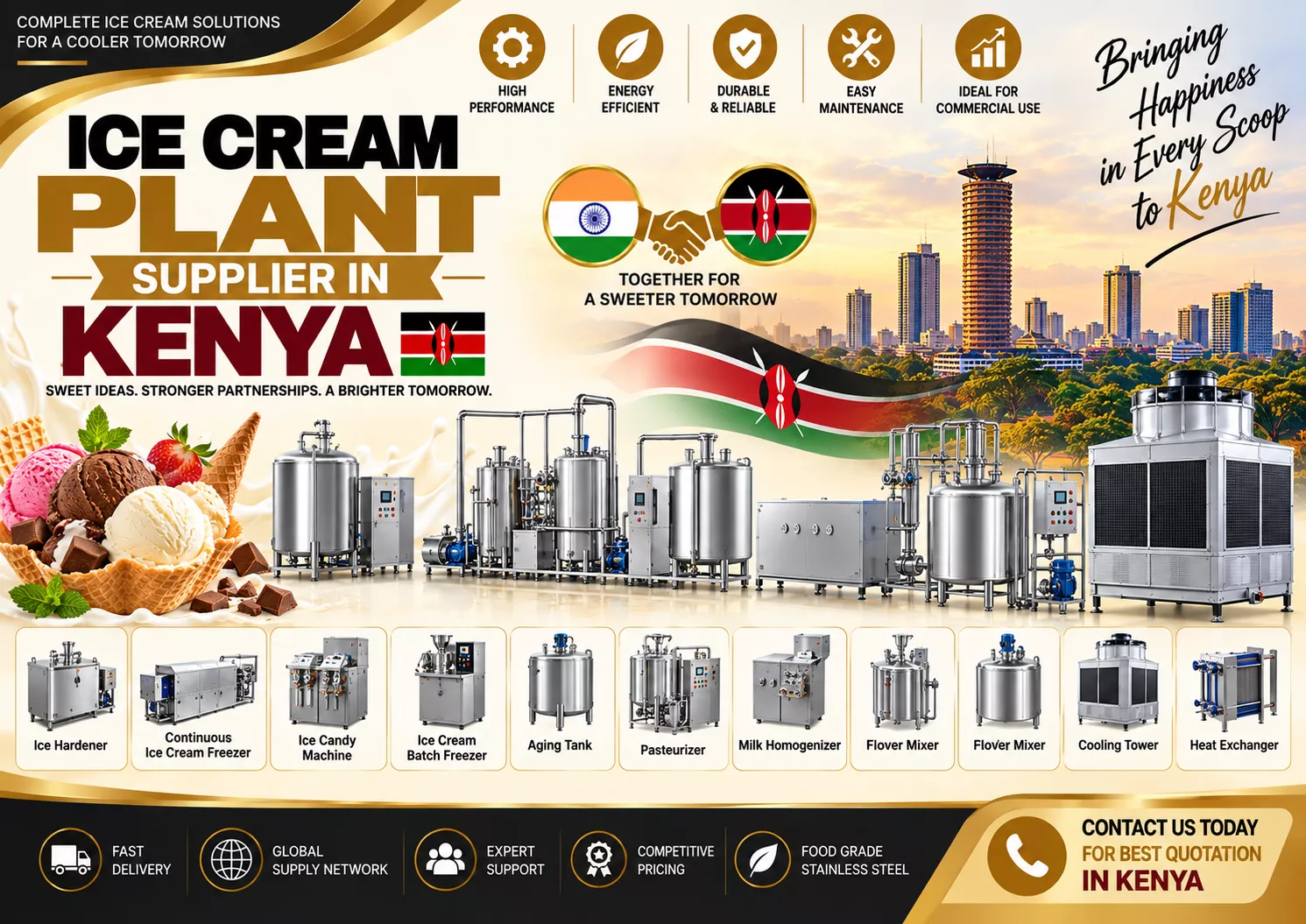
Ice Cream Plant Supplier In Kenya
An Ice Cream Plant Supplier In Kenya helps businesses build a commercial frozen-dessert production setup according to their required output, product range and packaging format. An ice cream plant is not simply one machine placed inside a factory. It is a coordinated production system in which ingredients are prepared, processed, cooled, frozen, packed and stored before the finished product reaches customers.
For a business entering the ice cream market, the biggest challenge is often not finding machinery. The bigger challenge is selecting machinery that fits the business model. A small brand selling a few hundred packs per day will have different requirements from a manufacturer supplying supermarkets, hotels, restaurants and distributors across several regions.
The planning should therefore begin with the product and expected sales rather than with a machine catalogue. Once the production target is clear, the plant can be designed around the required processing capacity.
Turn a Milk-Based Recipe Into a Commercial Product
Ice cream production starts with a formulation.
Milk, cream or other dairy ingredients can form part of the base, while sugar, milk solids, stabilizers, emulsifiers, flavours and other permitted ingredients are selected according to the product being developed.
The recipe determines many of the equipment requirements.
A business producing simple vanilla and chocolate products may need a relatively straightforward system. A manufacturer producing fruit pieces, nut varieties, sauces and ripple products needs more ingredient-handling flexibility.
A Ice Cream Plant Supplier In Kenya should therefore understand the product range before suggesting the processing line.
The first discussion should cover what the business wants to manufacture, how it will be packed and how much it expects to sell.
Contact Sri Brothers Enterprises today to discuss your Ice Cream Plant requirement and request a quotation.
Build the Factory Around Daily Output
Production capacity should not be selected simply because a machine has an impressive number attached to it.
A practical calculation starts with expected sales.
For example:
Expected daily sales → required finished product → production hours → hourly capacity → machine size
The business should then add reasonable room for growth.
A plant operating close to its maximum capacity every day may have difficulty handling seasonal demand. On the other hand, purchasing equipment several times larger than the current market can increase the initial investment and operating costs.
A Ice Cream Plant Supplier In Kenya can compare different production levels according to the customer’s actual requirements.
Commercial equipment available in Kenya includes smaller systems as well as machines and complete lines designed for higher production volumes. Current local equipment listings show ice cream processing configurations ranging from small-scale systems to hundreds of litres per hour.
Let us know if you need a machine or a complete plant.
This distinction is important.
A restaurant may only need an ice cream-making machine.
A small dessert business may require a mixer, freezer and filling arrangement.
A dairy processor entering the frozen-dessert market may need a complete processing section.
A larger manufacturer can require:
- Ingredient preparation
- Mix tanks
- Pasteurization
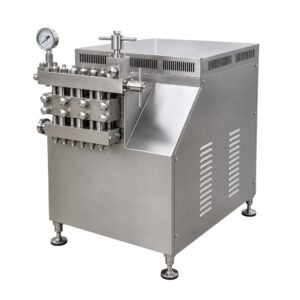
- Homogenization
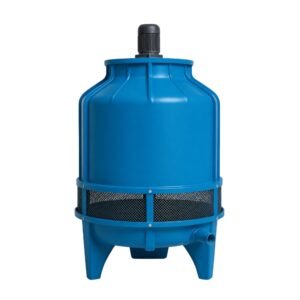
- Cooling
- Ageing
- Freezing
- Flavour addition
- Filling
- Sealing
- Hardening
- Cold storage
A Ice Cream Plant Supplier In Kenya can supply a standalone machine or develop a connected production system depending on the required scale.
The customer should explain the intended business size before asking for a final quotation.
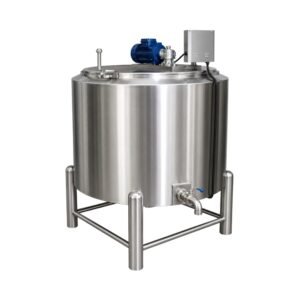
The Mixing Section Creates the Base
The first major production area is where ingredients are combined.
The mixing vessel should provide enough working volume for the required batch while giving the agitator sufficient movement to distribute ingredients throughout the liquid.
Powdered ingredients need to disperse properly. Sugar should dissolve according to the process. Fats and dairy components need to be incorporated into the mixture.
A suitable mixer may also be designed for heating, depending on the plant configuration.
The important specifications include:
- Working capacity
- Agitator design
- Motor arrangement
- Heating provision
- Product-contact material
- Cleaning access
- Outlet design
A Ice Cream Plant Supplier In Kenya should provide these details rather than describing the equipment only as a “high-quality mixer.”
Pasteurization Helps Keep the Mix Under Control
The prepared ice cream mix needs appropriate heat treatment as part of commercial processing.
The purpose is to provide a controlled process that supports food safety and product quality.
The pasteurizer should be selected according to the formulation, batch size and production schedule.
For a small operation, batch pasteurization may be practical.
For a larger manufacturing facility, a continuous system may be considered.
The important point is that the pasteurizer should not become the production bottleneck.
If the freezer can process much more product than the pasteurizer can prepare, the overall factory cannot achieve the freezer’s advertised output.
A Ice Cream Plant Supplier In Kenya should therefore calculate the capacities of connected machines together.
Homogenization Affects Product Structure
Homogenization is used to create a more uniform distribution of fat within the ice cream mix.
The homogenizer operates under pressure and needs to be selected according to the required product flow.
Its capacity should correspond with the pasteurization and cooling sections.
If the plant is designed for 500 litres per hour but one important machine can handle only a fraction of that flow, the line will not operate at its intended capacity.
For this reason, the buyer should request the rated capacity of each major component.
An Ice Cream Plant Supplier In Kenya can use these figures to balance the complete production line.
Cooling Comes Before the Next Production Stage
After heat treatment, the mix needs to be cooled.
The cooling stage prepares the product for chilled holding and later freezing.
The system can vary according to plant size. Smaller operations may use integrated refrigeration arrangements, while larger installations may use dedicated cooling systems connected to tanks and processing equipment.
The important considerations are:
- Cooling capacity
- Target product temperature
- Tank volume
- Refrigeration load
- Holding time
- Product transfer method
A well-planned cooling stage prevents the production schedule from becoming dependent on slow temperature reduction.
Why the Ageing Tank Is Important
The ageing tank is one of the less visible but important parts of an ice cream plant.
After cooling, the mix is held under controlled conditions before freezing. This period allows the formulation to develop properties that support the later freezing process.
The tank normally requires controlled cooling and agitation.
Its capacity should correspond with the amount of mix being produced.
If the mixing section prepares more product than the ageing section can comfortably hold, the production line may have to stop and wait.
A Ice Cream Plant Supplier In Kenya should therefore calculate the relationship between mixing capacity, pasteurizer capacity, ageing capacity and freezer capacity.
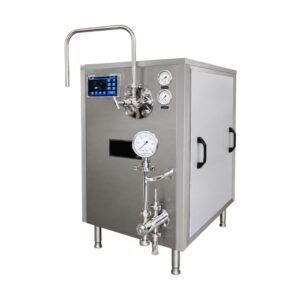
Freezing Is Where the Product Takes Shape
The freezer changes the chilled liquid mix into a semi-frozen ice cream product.
During this stage, the mixture is cooled rapidly while being agitated. Air is also incorporated according to the desired product characteristics.
The freezing process influences:
- Texture
- Body
- Density
- Melting behaviour
- Production speed
- Final product consistency
There are different types of commercial freezers.
A batch freezer processes a fixed quantity.
A continuous freezer works with a more constant product flow.
The right option depends on production volume and product strategy.
A Ice Cream Plant Supplier In Kenya should not select the freezer separately from the rest of the line.
Your Product Density Is a Business Decision Too
Air incorporated into ice cream affects its final volume and density.
This is generally discussed using the term overrun.
Different products can require different overrun targets depending on their formulation and market positioning.
A premium dense product and a lighter commercial product may not use the same process settings.
The freezer should therefore provide suitable control for the desired product.
A business should also establish a consistent operating procedure so that one batch does not become noticeably different from another.
Plan Flavours Before Installing the Line
Flavour management becomes increasingly important as the product range grows.
A company producing two flavours can organise production relatively simply.
A company producing ten or twenty flavours has to think about ingredient storage, flavour dosing, changeovers and cleaning.
Some products may also require:
- Fruit preparation
- Nut feeding
- Chocolate addition
- Sauce preparation
- Ripple injection
- Cookie pieces
- Other inclusions
A Ice Cream Plant Supplier In Kenya should receive the complete flavour list before finalising the plant.
This can determine whether additional tanks, feeders or dosing equipment are necessary.
Inclusions Need Controlled Feeding
Solid ingredients cannot always be added in the same way as liquid flavours.
Nuts, chocolate pieces, fruit pieces and similar ingredients may need controlled feeding into the semi-frozen product.
The feeder should provide consistent addition without causing blockages or uneven distribution.
For a manufacturer with several speciality products, an inclusion system can improve production flexibility.
However, it should only be installed when the product range justifies it.
This is another reason why an Ice Cream Plant Supplier In Kenya should design the line around the actual products instead of selling an identical configuration to every customer.
Packaging Should Be Decided Early
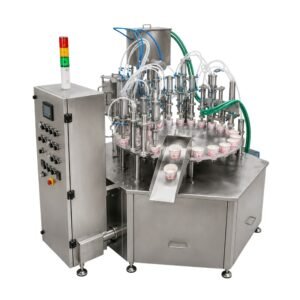
The final package determines the filling equipment.
Possible formats include:
- Small cups
- Family tubs
- Cones
- Bulk containers
- Moulded products
- Special promotional packs
Each format has different filling and handling requirements.
A business selling single-serve cups may require automatic filling and sealing.
A manufacturer selling large family tubs needs equipment capable of handling larger filling volumes.
A Ice Cream Plant Supplier In Kenya can match the filling section to the packaging strategy.
The number of packages per minute should also be compared with freezer output.
The Filling Machine Can Become a Bottleneck
Imagine the freezer produces product faster than the packaging line can accept it.
The product then begins accumulating between the two stages.
The opposite problem can also occur. A fast filling line may spend much of its time waiting for product from a slow freezer.
For this reason, production rates should be balanced.
A complete quotation should clearly show the expected output of:
Mixing → processing → freezing → filling → hardening
The goal is not to maximise one machine. The goal is to keep the entire system productive.
Hardening Makes the Product Ready for Storage
Ice cream leaving the freezer is not necessarily firm enough for long-term storage.
Hardening removes additional heat and helps the packaged product reach the required frozen condition.
Small operations may use dedicated freezer rooms or cabinets.
Larger plants can use hardening tunnels designed for continuous product movement.
A Ice Cream Plant Supplier In Kenya should recommend the hardening method according to:
- Product volume
- Package size
- Conveyor speed
- Factory space
- Refrigeration capacity
- Required production schedule
Cold Storage Is Part of Production Capacity
Finished ice cream needs appropriate frozen storage before dispatch.
Cold-room capacity should be calculated according to the amount of product the business expects to keep on hand.
The business should consider both normal stock and periods of increased demand.
The cold store should also allow practical movement of products, stock identification and cleaning.
A factory that produces large quantities but has insufficient frozen storage may be forced to slow production.
Therefore, cold storage should be included when calculating total plant capacity.
Distribution Must Protect the Product
An ice cream factory does not control product quality only inside the building.
The cold chain continues during transportation and distribution.
Depending on the business model, finished products may move through:
Factory → cold store → refrigerated transport → distributor → retailer → customer
Every stage needs suitable temperature management.
Businesses supplying supermarkets and distant distributors should consider refrigerated transportation as part of their overall investment plan.
An Ice Cream Plant Supplier In Kenya can help identify where refrigeration and frozen storage should be incorporated into the factory layout.
Utility Requirements Can Change the Plant Budget
A production line needs more than machinery.
Depending on the configuration, the facility may require:
- Electrical power
- Water
- Refrigeration
- Drainage
- Compressed air
- Heating
- Ventilation
- Cold storage
- Cleaning systems
The actual requirements depend on the selected equipment.
Before ordering, request a utility schedule showing power requirements, water needs, refrigeration requirements and other services.
This allows the factory building to be prepared before machinery arrives.
Water and Drainage Need Attention
Food-processing facilities require water for production and cleaning.
Drainage becomes especially important because equipment, floors and processing areas need regular washing.
The factory should have suitable drainage paths so water does not remain around equipment.
Machine placement should leave enough room for operators to clean the surrounding area.
A poorly planned floor layout can create maintenance and hygiene problems even when the machinery itself is well designed.
Food-Contact Construction
Ice cream processing equipment should use suitable food-contact materials.
Stainless steel is widely used in commercial dairy equipment because it provides durable and cleanable surfaces.
The buyer should ask for the actual material grade rather than accepting a general statement that the machine is “food grade.”
Important areas include:
- Mix tanks
- Pipes
- Valves
- Pumps
- Freezer components
- Filling parts
- Product outlets
- Storage tanks
The equipment should also be designed so product-contact areas can be inspected and cleaned properly.
Cleaning Should Be Planned With the Plant
A large ice cream factory may contain many connected components.
Cleaning can involve tanks, pipes, valves, pumps, freezers and fillers.
Depending on the design, a clean-in-place system may be used for suitable sections of the production line.
The buyer should ask which components are included in CIP and which require manual cleaning.
A Ice Cream Plant Supplier In Kenya should provide a clear cleaning procedure for the supplied equipment.
The cleaning system should be considered during factory planning because it can influence water use, drainage and chemical handling.
Automation Should Have a Purpose
Automation can improve production control, but it should be selected according to actual business needs.
A smaller factory may benefit from automatic temperature control and digital monitoring while keeping some operations manual.
A larger manufacturer may automate:
- Ingredient dosing
- Valve operation
- Product transfer
- Temperature monitoring
- Freezing
- Filling
- Sealing
- Conveyor movement
The question should not be “Do I need a fully automatic plant?”
The better question is “Which production tasks create the greatest labour or consistency problem?”
An Ice Cream Plant Supplier In Kenya can then suggest useful automation rather than unnecessary complexity.
Operator Training Should Be Included
A modern production line still needs trained operators.
Employees should understand:
- Start-up procedures
- Ingredient handling
- Temperature settings
- Production sequence
- Cleaning
- Basic troubleshooting
- Safety procedures
- Shutdown procedures
Training is especially important when several machines are connected.
A problem in the mixing stage can affect freezing later in the line, so operators should understand how the complete system works.
Maintenance Planning Before Production Starts
Preventive maintenance is easier than waiting for a breakdown.
The business should establish inspection routines for:
- Motors
- Pumps
- Bearings
- Valves
- Seals
- Refrigeration components
- Sensors
- Control panels
- Freezer parts
- Filling equipment
The supplier should identify common wear components and recommended service intervals.
A Ice Cream Plant Supplier In Kenya should also explain how spare parts and technical assistance will be handled after installation.
Spare Parts Can Affect Production Continuity
A small component can stop a large production line.
For example, a failed seal, sensor or valve may prevent the plant from operating correctly even when the major machines are functioning.
Before purchasing, ask which spare parts should be kept at the factory.
Also ask:
- How quickly can parts be supplied?
- Are standard components used?
- Is technical support available remotely?
- Is installation support provided?
- What does the warranty cover?
These questions help estimate the practical cost of operating the plant.
Choose a Plant According to Your Stage of Business
A startup should not necessarily purchase the same type of plant as an established manufacturer.
A startup may begin with a smaller production line and expand later.
A growing company may need additional freezing and filling capacity.
An established dairy company may be able to integrate ice cream production into its existing milk-processing infrastructure.
A Ice Cream Plant Supplier In Kenya should evaluate the current business stage before recommending equipment.
The ideal plant is the one that can meet current requirements without creating unnecessary financial pressure while still allowing sensible growth.
A Dairy Business Can Add Ice Cream as Value Addition
Businesses already processing milk may have an opportunity to use their existing resources for additional products.
An established dairy operation may already have:
- Milk reception
- Chilling
- Storage
- Refrigeration
- Quality-control facilities
- Distribution
- Technical staff
An ice cream section can potentially be designed around some of this existing infrastructure.
This can make the project different from building an entirely new factory.
The supplier should inspect or review existing facilities before recommending duplicate equipment.
What Should Be Included in a Project Proposal?
A proper plant proposal should describe the complete project.
The buyer should expect information about:
Production capacity
Expected output per hour or day.
Processing equipment
Machines included in the mix-processing section.
Freezing equipment
Type and capacity of freezer.
Packaging equipment
Supported formats and output.
Hardening
Method and expected capacity.
Cold storage
Recommended storage volume.
Utilities
Electrical, water, refrigeration and other requirements.
Installation
Scope of installation work.
Training
Operator and maintenance training.
Warranty
Coverage period and components.
Spare parts
Recommended stock and supply arrangement.
A Ice Cream Plant Supplier In Kenya should make these details clear before the order is finalised.
How to Request a Correct Quotation
A buyer can make the quotation process easier by providing complete information.
Send the supplier:
- Target daily production
- Target hourly production
- Number of flavours
- Product types
- Package sizes
- Packaging format
- Current milk-processing facilities
- Available electricity
- Available water
- Available floor space
- Cold-storage requirement
- Desired automation
- Future expansion target
This prevents the supplier from making assumptions.
It also makes quotations from different suppliers easier to compare.
Why Choose Us?
We provide ice cream production solutions based on the customer’s actual manufacturing requirements.
Our approach considers the complete process rather than focusing on one machine. Production capacity, mix preparation, processing, freezing, filling, hardening, storage, utilities and future expansion are considered together.
As an Ice Cream Plant Supplier In Kenya, we can support businesses planning new ice cream manufacturing facilities as well as existing dairy and food companies looking to add frozen-dessert production.
The plant can be planned for a smaller commercial operation or a larger integrated production facility according to the required output.
The objective is to create a balanced production system in which each major stage can support the next stage without unnecessary bottlenecks.
Frequently Asked Questions
An ice cream plant is a combination of processing, freezing, filling, hardening and storage equipment used to manufacture ice cream commercially.
Yes. An ice cream machine may perform a specific operation, while an ice cream plant can contain several connected machines covering multiple stages of production.
The exact setup depends on capacity, but it can include mixing tanks, pasteurizers, homogenizers, ageing tanks, freezers, flavour equipment, fillers, hardening systems and cold storage.
Start with expected daily sales and calculate the required hourly production. Then consider seasonal demand and future business growth.
Yes. An existing dairy business may already have infrastructure that can support some parts of an ice cream production project. The new equipment should be planned around the existing facilities.
It holds the chilled ice cream mix under controlled conditions before freezing. This allows the mix to develop properties useful for the freezing stage.
A batch freezer processes a defined quantity at a time, while a continuous freezer is designed for a steady flow of product. The suitable choice depends on production scale and operating style.
Not necessarily, but a larger flavour range may require additional dosing, flavouring or inclusion equipment. Production scheduling and cleaning also become more important.
Depending on the filling system, commercial ice cream can be packed into cups, tubs, cones, bulk containers and other formats.
Commercial businesses generally need suitable frozen storage for finished products. The required size depends on production volume and distribution plans.
Yes, some plant layouts can be designed with future expansion in mind. Additional tanks, freezing capacity, filling equipment or storage may be added depending on the original design.
Check capacity, product range, machine specifications, utility requirements, factory layout, packaging, refrigeration, cleaning, installation, training, warranty and spare-parts support.
Conclusion
An ice cream factory should be designed around the complete production journey rather than around a single machine.
The mix must be prepared correctly, processed under controlled conditions, cooled, aged, frozen, packed, hardened and stored before it is ready for distribution.
An Ice Cream Plant Supplier In Kenya can help businesses connect these stages according to their required capacity and product range.
For a startup, the focus may be on creating a manageable first production line. For an established dairy business, the project may involve integrating ice cream production with existing infrastructure. For a larger manufacturer, automation, continuous freezing, high-speed packaging and expanded cold storage may become more important.
The most suitable plant is therefore the one that matches the business’s current production needs while providing a practical path for future growth.


Add a review
Your email address will not be published. Required fields are marked *