
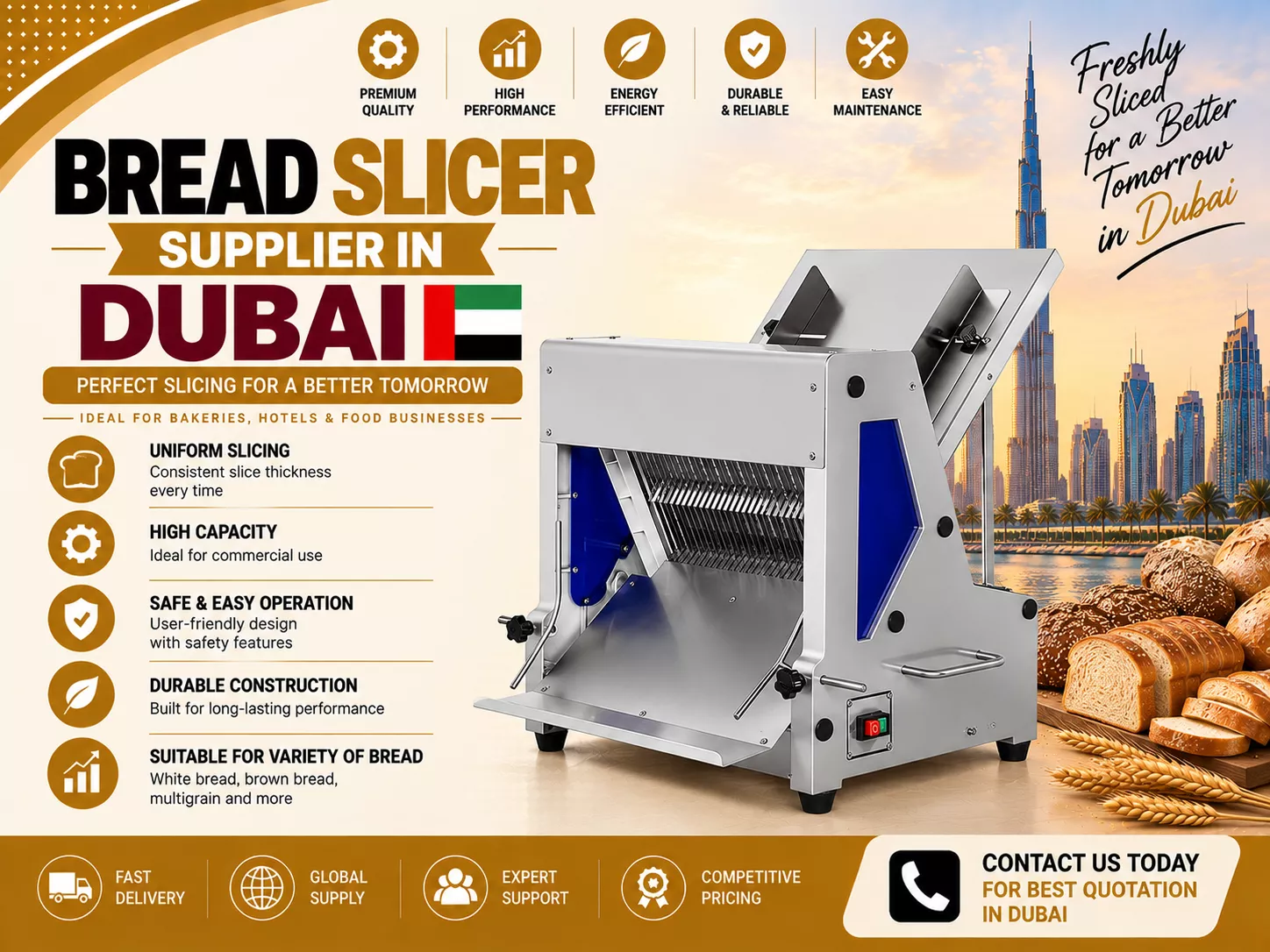
Bread Slicer Supplier in Dubai
A Complete Commercial Buying Guide
Choosing the right Bread Slicer Supplier in Dubai is important for bakeries, hotels, supermarkets, cafés, restaurants, sandwich shops, catering companies, and commercial bread-production facilities. A commercial bread slicer can help produce uniform slices, improve production speed, reduce manual cutting, and create a more consistent finished product.
Dubai has an established bakery-equipment market with bread slicers available for small bakeries as well as high-volume commercial production. Current UAE offerings include compact slicers with fixed slice thickness, tabletop models, automatic bread slicers with adjustable thickness, and high-speed industrial systems designed for significantly higher throughput.
For businesses searching for a Bread Slicer Supplier in Dubai, the purchase decision should go beyond the machine price. Important considerations include loaf dimensions, slice thickness, slicing capacity, blade design, motor power, electrical requirements, machine construction, safety features, cleaning requirements, installation, spare parts, warranty, and after-sales service.
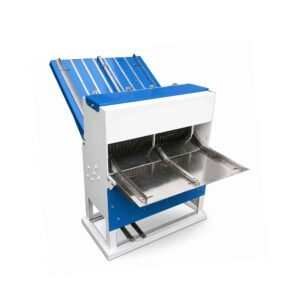
Double Bread Slicer Machine
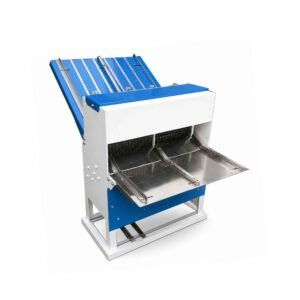
Rusk Cutter Machine
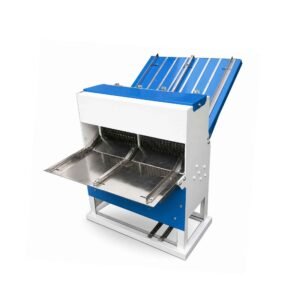
High Speed Bread Slicer
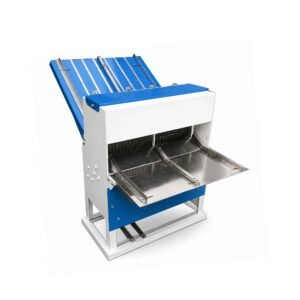
Bread Slicer Machine
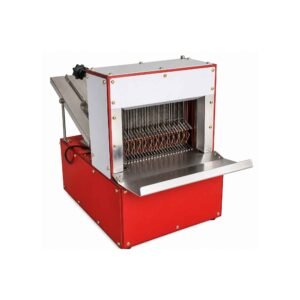
Table Top Bread Slicer Machine
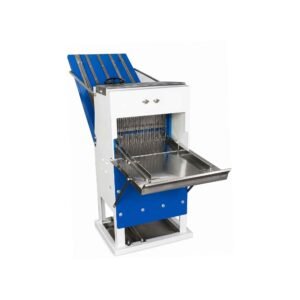
Single Bread Slicer Machine
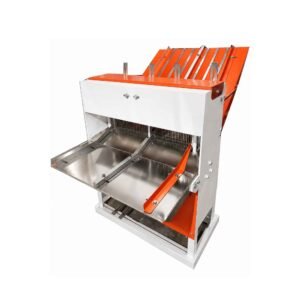
Rusk Cutting Machine
What Is a Commercial Bread Slicer?
on the machine design, slicing can be performed using multiple straight blades, reciprocating blades, or a circular cutting system.
Commercial bread slicers are designed to provide more consistent results and faster production than manual slicing.
They can be used for:
- Sandwich bread
- Toast bread
- White bread
- Whole-wheat bread
- Multigrain bread
- Soft bread
- Buns and selected bakery products
- Specialty loaves
- Packaged bread
The correct slicer depends on the shape, size, texture, and production volume of the bread.
Contact Sri Brothers Enterprises today to discuss your bread slicer requirement and request a quotation.
How Does a Bread Slicing Machine Work?
The exact operating principle depends on the machine design.
In a conventional multi-blade slicer, the loaf is positioned in the loading area and moved through a series of blades. The blades cut the loaf into predetermined slices.
Automatic models can use a feeding mechanism to move the loaf through the cutting section while maintaining a consistent slicing pattern.
The general process is:
- Place the cooled bread loaf into the loading area.
- Adjust or select the required slice thickness where applicable.
- Secure or position the loaf correctly.
- Start the machine.
- The loaf moves through the cutting system.
- Multiple blades produce uniform slices.
- The sliced loaf is removed for packaging or further processing.
Modern automatic models can provide programmable or adjustable slicing parameters depending on their design.
Why Use a Commercial Bread Slicer in Dubai?
A professionally selected bread slicer can provide several operational advantages.
Consistent Slice Thickness
Uniform slicing gives packaged bread a more consistent appearance and can improve portion control.
Faster Production
Mechanical slicing is considerably more efficient than manually cutting large quantities of bread.
Reduced Labour
Automating the slicing stage can reduce repetitive manual work.
Improved Product Presentation
Consistent slices can help produce a more professional retail product.
Better Portion Control
Standardized slice thickness can help businesses maintain consistency across batches.
Reduced Slicing Variability
Manual slicing can result in differences between operators. A properly adjusted machine provides a more repeatable result.
Types of Bread Slicers Available in Dubai
When selecting a Bread Slicer Supplier in Dubai, it is important to understand the different machine types.
Manual Bread Slicer
Manual or semi-automatic machines require the operator to position and feed the loaf.
They can be suitable for:
- Small bakeries
- Cafés
- Restaurants
- Low-volume production
They are generally simpler to operate and can require less investment than fully automatic systems.
Semi-Automatic Bread Slicer
Semi-automatic machines reduce manual effort while still requiring operator involvement in loading or feeding.
They can be useful for growing bakeries that need increased productivity without investing in a fully automated production line.
Automatic Bread Slicer
Automatic bread slicers can feed and slice loaves with reduced operator intervention.
A current UAE-market automatic model is specified for loaves up to approximately 40 cm long and provides adjustable slicing thickness from 4–24 mm. It is positioned for bakeries, supermarket production areas, and food-distribution operations.
High-Speed Bread Slicer
High-speed slicers are designed for large commercial bakeries and production lines.
Current industrial examples include systems rated at approximately 1,000–1,200 loaves per hour, depending on the model and operating conditions.
Fixed vs Adjustable Slice Thickness
Slice thickness is one of the most important specifications.
Fixed Slice Thickness
Some commercial slicers are designed for a predetermined slice thickness. For example, a current Dubai-market listing specifies 12 mm slices and 30 stainless-steel blades.
Fixed-thickness machines can be suitable when a bakery produces a standardized bread product.
Adjustable Slice Thickness
Adjustable slicers provide greater flexibility for businesses producing different bread formats.
One current UAE automatic model provides a 4–24 mm thickness range, while another tabletop model provides a 9–18 mm range.
The required range should be selected according to the bakery’s actual products rather than choosing the widest possible range.
Blade System
The blade arrangement has a direct effect on slicing performance.
Important factors include:
- Blade material
- Number of blades
- Blade thickness
- Blade spacing
- Blade tension
- Blade replacement procedure
- Blade durability
Stainless-steel blades are common in commercial bread slicers. A current Dubai listing for a commercial EMPERO slicer specifies 30 stainless-steel blades and a 16 mm slice thickness.
For industrial equipment, ask the supplier how frequently blades normally require replacement and whether replacement sets are readily available.
Bread Size and Slicer Compatibility
A bread slicer must match the dimensions of the loaves being produced.
Important measurements include:
- Maximum loaf length
- Maximum loaf width
- Maximum loaf height
- Minimum loaf height
- Maximum loaf weight
- Bread shape
Current commercial models demonstrate substantial variation.
One automatic slicer listed for the UAE can handle bread dimensions of approximately 40 × 16 × 36 cm.
A tabletop model lists maximum loaf dimensions of approximately 44 × 26 × 16 cm with its safety cover engaged.
An EMPERO commercial model listed in Dubai specifies a maximum bread length of 500 mm and bread height of 140 mm.
These figures are model-specific, so the supplier should confirm compatibility with your actual bread dimensions before purchase.
Bread Slicer Capacity
Production capacity is another major consideration when choosing a Bread Slicer Supplier in Dubai.
Capacity can be expressed as:
- Loaves per hour
- Loaves per minute
- Slices per minute
- Production-line throughput
However, rated capacity should not automatically be treated as guaranteed production under every operating condition.
Actual output can depend on:
- Loaf size
- Bread temperature
- Bread texture
- Operator loading
- Slice thickness
- Feeding speed
- Machine configuration
- Packaging workflow
For example, a high-speed industrial bread slicer can be rated around 1,000–1,200 loaves per hour, while compact tabletop machines are designed for substantially smaller operations.
Bread Temperature and Slicing Quality
Bread temperature can affect slicing performance.
Freshly baked bread may still contain significant internal moisture and can be softer and more difficult to slice cleanly.
Depending on the bread formulation and slicer design, bread may need adequate cooling before high-speed slicing.
A professional bakery should establish a suitable workflow between:
Baking → Cooling → Slicing → Packaging
This helps reduce problems such as:
- Crushed bread
- Uneven slices
- Torn crumb
- Excessive crumbs
- Product deformation
Some modern slicers are specifically designed to handle fresh or slightly warm bread through oil-free cutting systems.
Key Specifications to Compare
When evaluating a Bread Slicer Supplier in Dubai, compare the complete specification rather than just the advertised price.
Specification | What to Check |
Machine Type | Manual, semi-automatic, or automatic |
Production Capacity | Loaves per hour |
Slice Thickness | Fixed or adjustable |
Blade Type | Straight, reciprocating, or circular |
Blade Material | Stainless steel or specified food-grade material |
Number of Blades | Total cutting blades |
Blade Spacing | Distance between blades |
Maximum Loaf Length | Maximum supported length |
Maximum Loaf Width | Maximum supported width |
Maximum Loaf Height | Maximum supported height |
Minimum Loaf Height | Minimum supported height |
Bread Compatibility | Types of bread supported |
Motor Power | Motor rating |
Voltage | Required electrical voltage |
Phase | Single-phase or three-phase |
Frequency | Required operating frequency |
Control System | Manual, electronic, digital, or programmable |
Feeding System | Manual or automatic |
Safety Guard | Protective cover and interlock |
Emergency Stop | Emergency shutdown system |
Construction | Stainless steel and food-safe components |
Machine Dimensions | Overall footprint |
Machine Weight | Total equipment weight |
Mobility | Fixed, wheels, or casters |
Cleaning | Ease of cleaning and sanitation |
Installation | Delivery and commissioning |
Warranty | Warranty coverage |
Spare Parts | Availability and lead time |
Service | Technical and maintenance support |
Exact specifications should always be verified against the manufacturer’s datasheet for the selected model.
Electrical Requirements
Electrical compatibility should be confirmed before ordering.
Compact commercial machines can have relatively modest electrical requirements. For example, one current bread slicer listing specifies 220 V, 50 Hz, and 0.25 kW.
A high-speed industrial model can require substantially more power. One current example specifies 1.5 HP and 415 V, three-phase power.
Therefore, never assume that every bread slicer has the same electrical requirements.
Before installation, verify:
- Voltage
- Phase
- Frequency
- Connected load
- Breaker requirement
- Cable requirement
- Earthing
Construction and Hygiene
A commercial bread slicer operates directly with food products, so hygiene and cleanability are important.
Stainless-Steel Construction
Stainless steel can provide durability and facilitate cleaning.
Food-Contact Components
Blades, guides, conveyors, and other components that contact bread should be appropriate for food-processing applications.
Easy Cleaning
The machine should allow operators to remove crumbs and food residues efficiently.
Enclosed Components
Modern designs may protect motors and other internal components from flour dust and moisture.
One current UAE automatic slicer uses a stainless-steel cabinet, membrane keypad, and sealed motor housing to support hygiene and equipment protection.
Safety Features
Bread slicers contain moving blades and therefore require appropriate operator protection.
Depending on the model, safety features may include:
- Blade guards
- Protective covers
- Safety interlocks
- Emergency-stop buttons
- Automatic shutdown
- Enclosed cutting systems
- Secure loaf positioning
- Protective feeding mechanisms
Operators should be trained to avoid placing hands near the cutting mechanism during operation.
Cleaning, blade replacement, and maintenance should only be performed according to the manufacturer’s safety procedure.
Applications of Bread Slicers in Dubai
Commercial Bakeries
Bread slicers are commonly used for packaged bread and retail bakery products.
Supermarket Bakeries
In-store bakeries can use compact or automatic slicers to prepare bread for retail sale.
Hotels
Hotels can use bread slicers in central bakery and breakfast-production operations.
Restaurants
Restaurants producing sandwich bread, toast bread, or specialty loaves can use commercial slicing equipment.
Cafés
Compact tabletop models may be suitable for cafés with moderate slicing requirements.
Catering Companies
Catering businesses can benefit from consistent slicing when preparing large quantities of sandwiches and bread-based products.
Industrial Bread Production
High-speed slicing systems can be integrated into larger bread-production lines.
A complete commercial workflow may include:
Dough Mixing → Dividing → Moulding → Proofing → Baking → Cooling → Slicing → Packaging
How to Choose the Right Bread Slicer Supplier in Dubai
Selecting the supplier is just as important as selecting the machine.
Technical Consultation
The supplier should understand your:
- Bread dimensions
- Daily production
- Required slice thickness
- Production speed
- Bread formulation
- Packaging process
Demonstration or Testing
Where possible, ask whether the machine can be tested using your actual bread product.
This can reveal issues that may not be obvious from a specification sheet.
Installation
Larger commercial machines may require professional positioning, assembly, electrical connection, and commissioning.
Spare Parts
Ask about the availability of:
- Blades
- Belts
- Bearings
- Motors
- Sensors
- Safety switches
- Control components
Maintenance
Preventive maintenance helps maintain slicing accuracy and reduce unexpected downtime.
Dubai has numerous commercial bakery-equipment businesses. Current local listings include Altuntop Bakery Equipment, Paramount Kitchen & Bakery Equipment -Dubai, AL BAYAN KITCHEN EQUIPMENT LLC and Al Diwan Kitchen & Laundry Equipment LLC. These businesses are examples of the local bakery-equipment ecosystem; their specific models, pricing, availability, and service terms should be independently confirmed.
Bread Slicer Price in Dubai
The price of a bread slicer in Dubai varies according to machine type, capacity, blade system, automation, construction, brand, and features.
Current listings demonstrate a broad range.
For example:
- A compact 30-slice commercial model is currently listed at AED 1,600, with 12 mm slicing, 220 V / 50 Hz, and 0.25 kW.
- A heavy-duty EMPERO model is currently listed at approximately AED 7,199.50, with 30 stainless-steel blades, 16 mm slicing, and a 0.37 kW motor.
- A current automatic bread slicer has adjustable 4–24 mm slicing and a 130 kg machine weight, illustrating a more sophisticated commercial configuration.
These are specific current listings, not universal Dubai market prices. Prices can change according to brand, specifications, promotions, delivery, installation, and warranty.
For a meaningful quotation comparison, request pricing for the same:
- Loaf capacity
- Slice thickness
- Production capacity
- Blade configuration
- Motor power
- Electrical specification
- Accessories
- Installation
- Warranty
- After-sales service
Installation Requirements
Before purchasing a commercial bread slicer, evaluate the installation location.
Floor Space
Allow sufficient space for:
- Bread loading
- Sliced-bread unloading
- Operator movement
- Cleaning
- Maintenance
Electrical Connection
The electrical connection should match the manufacturer’s specifications.
Delivery Access
For larger machines, check:
- Door width
- Corridor clearance
- Elevator dimensions
- Elevator load capacity
- Loading access
Production Flow
Position the slicer logically after the bread-cooling stage and before packaging.
A well-planned layout can reduce unnecessary movement and improve production efficiency.
Maintenance of a Bread Slicer
Regular maintenance helps preserve slicing quality and machine reliability.
Recommended practices include:
- Remove bread crumbs regularly.
- Clean food-contact surfaces.
- Inspect blades.
- Check blade tension where applicable.
- Inspect belts and drive components.
- Check safety guards.
- Test safety interlocks.
- Inspect emergency-stop operation.
- Check motor performance.
- Inspect electrical connections.
- Lubricate components where specified.
- Replace worn blades according to manufacturer recommendations.
- Schedule preventive maintenance.
Cleaning procedures should follow the manufacturer’s instructions, particularly around motors, electrical components, sensors, and control panels.
Common Mistakes When Buying a Bread Slicer
Choosing Only by Price
A cheaper machine may have lower capacity, fewer features, or higher long-term maintenance requirements.
Ignoring Loaf Dimensions
A slicer must accommodate the actual dimensions of your bread.
Ignoring Slice Thickness
A machine designed for one thickness may not meet your product requirements.
Choosing Excessive Capacity
An industrial slicer may be unnecessary for a small bakery.
Choosing Insufficient Capacity
An undersized slicer can become a bottleneck after baking.
Ignoring Bread Temperature
The slicing process should be matched to the bread’s cooling characteristics.
Not Testing Your Bread
Different bread formulations behave differently during slicing.
Ignoring Blade Availability
Replacement blades should be readily obtainable.
Neglecting After-Sales Service
A commercial slicer can become a critical production asset, so service availability matters.
What Makes a Reliable Bread Slicer Supplier?
A professional Bread Slicer Supplier in Dubai should demonstrate the principles of Experience, Expertise, Authority, and Trust.
Experience
Experience helps a supplier understand different bakery production environments and bread-processing requirements.
Expertise
Technical expertise is needed to match the slicer with bread dimensions, production volume, slice thickness, and workflow.
Authority
A credible supplier should provide:
- Technical datasheets
- Manufacturer information
- Operating instructions
- Warranty details
- Safety documentation
- Spare-parts information
Trust
Trust is built through accurate specifications, transparent pricing, realistic delivery commitments, clear warranty terms, and responsive service.
A professional supplier should recommend the machine according to your actual production requirements rather than simply offering the largest available model.
Questions to Ask Before Ordering
Before purchasing from a Bread Slicer Supplier in Dubai, ask:
- What is the maximum loaf length?
- What is the maximum loaf width?
- What is the maximum loaf height?
- What is the minimum loaf height?
- What slice thickness is available?
- Is the slice thickness adjustable?
- How many blades does the machine have?
- What material are the blades made from?
- What is the production capacity?
- What is the motor power?
- What voltage is required?
- Is three-phase power required?
- Is the feeding system manual or automatic?
- Does the machine have a safety interlock?
- Is an emergency stop included?
- Can the machine handle fresh or slightly warm bread?
- Can the machine be tested with our bread?
- Are replacement blades available?
- Is installation included?
- What warranty and after-sales support are provided?
These questions help buyers compare equipment on actual operational requirements rather than marketing claims.
Frequently Asked Questions
A bread slicer is used to cut bread loaves into uniform slices for retail sale, sandwiches, toast, food service, and commercial bakery production.
The correct slicer depends on loaf dimensions, daily production, required slice thickness, bread type, and available space. Small bakeries may use compact or tabletop models, while high-volume facilities may require automatic or conveyorized systems.
It depends on the model. Current UAE examples include fixed 12 mm slicing, 16 mm slicing, and adjustable ranges such as 4–24 mm or 9–18 mm.
Some modern slicers are specifically designed for fresh or slightly warm bread, but performance depends on bread formulation, temperature, machine design, and cutting system.
Capacity varies significantly. Compact machines are designed for smaller production, while current industrial examples can reach approximately 1,000–1,200 loaves per hour.
Consider loaf compatibility, slice thickness, production capacity, blade quality, machine construction, electrical requirements, safety features, installation, spare parts, warranty, and after-sales service.
Prices vary significantly. Current listings range from approximately AED 1,600 for a compact commercial slicer to more than AED 7,000 for certain heavy-duty models, while automated industrial systems can cost substantially more. These are current model-specific listings rather than fixed market prices.
For bakeries selling sliced bread at meaningful volumes, a commercial slicer can improve consistency and production efficiency. The appropriate level of automation depends on the bakery's output.
There is no universal replacement interval. Blade life depends on usage, bread type, cleaning practices, blade material, and operating conditions. Inspect blades regularly and follow the manufacturer's replacement recommendations.
Conclusion
Choosing the right Bread Slicer Supplier in Dubai requires careful consideration of the machine’s slicing performance, bread compatibility, capacity, construction, safety, and long-term service support.
The right slicer should match your loaf dimensions, required slice thickness, daily production volume, bread formulation, cooling process, packaging workflow, and available electrical infrastructure.
A reliable Bread Slicer Supplier in Dubai should provide technical consultation, accurate specifications, installation assistance, operator guidance, replacement blades, maintenance support, warranty coverage, and dependable after-sales service.
Before purchasing, compare slice thickness, blade configuration, loaf dimensions, production capacity, motor power, electrical requirements, safety features, construction quality, cleaning requirements, warranty, and spare-parts availability.
For a small bakery, a compact slicer may be sufficient. A growing commercial bakery may benefit from an automatic machine, while a high-volume bread producer may require a conveyorized high-speed slicing system.
The most suitable equipment is therefore not necessarily the cheapest or largest machine. It is the bread slicer that provides the appropriate combination of slicing consistency, production capacity, hygiene, safety, reliability, and long-term operating value.

Add a review
Your email address will not be published. Required fields are marked *