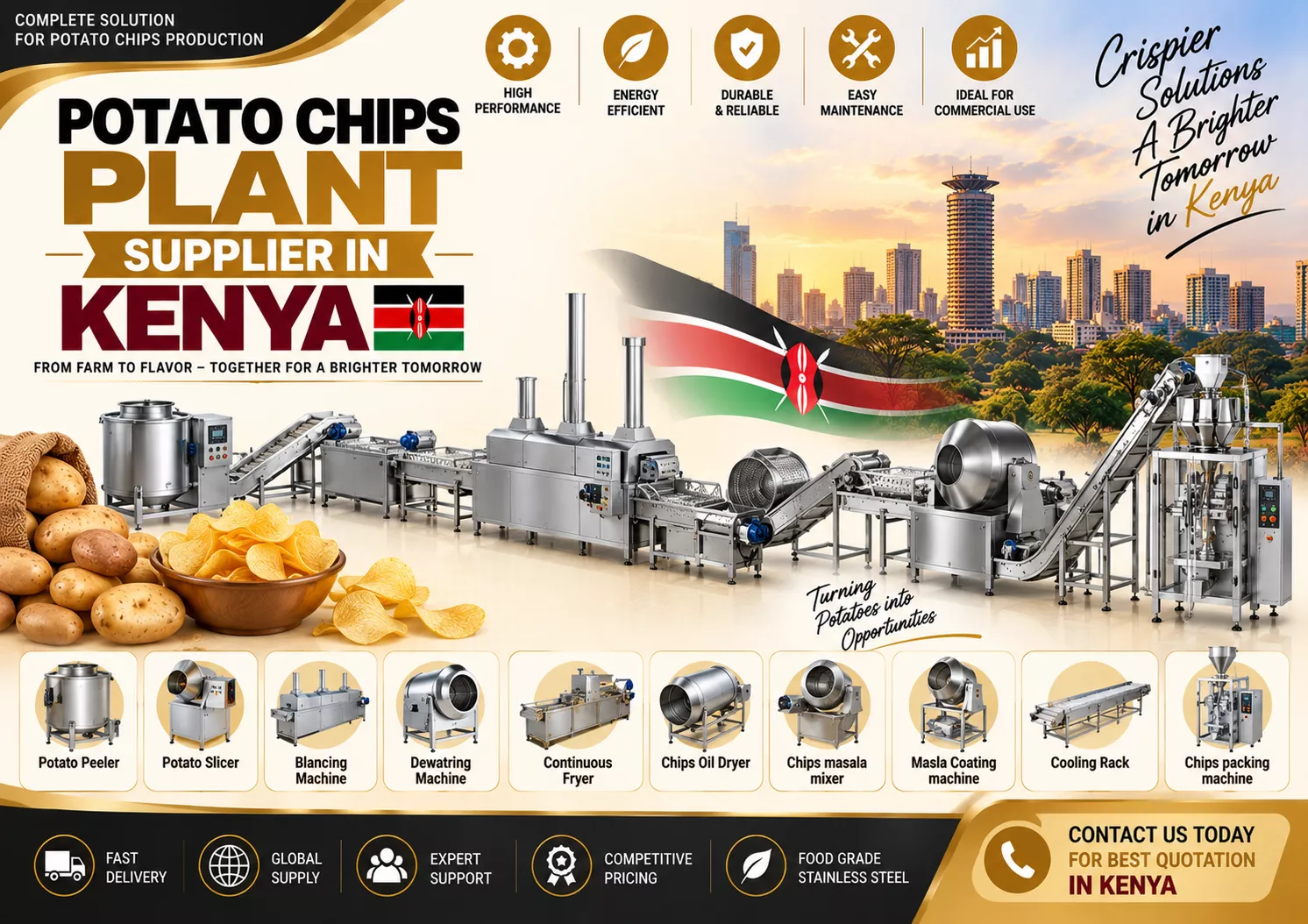
Potato Chips Plant Supplier In Kenya
Kenya’s food-processing sector provides opportunities for businesses that want to turn locally available agricultural products into packaged foods with longer shelf life and wider distribution potential. Potato chips are one such product. A properly planned facility from a reliable Potato Chips Plant Supplier In Kenya can transform fresh potatoes into consistent, ready-to-pack snack products through a sequence of cleaning, preparation, cooking, seasoning, cooling, and packaging operations.
For entrepreneurs, snack manufacturers, wholesalers, and established food companies, choosing the right Potato Chips Plant Supplier In Kenya is an important step before investing in processing equipment. The supplier needs to understand the complete production requirement rather than simply supplying individual machines. Capacity, product quality, automation, utilities, available space, maintenance, and future expansion all influence the final plant configuration.
This guide explains how a potato chips plant works, which machines may be required, how to select equipment, and what buyers should consider before setting up a commercial potato chips processing operation in Kenya.
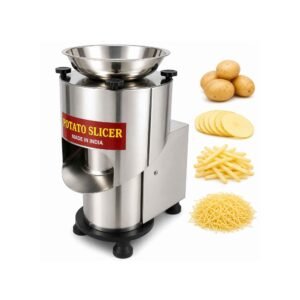
Potato Chips Making Machine 100 Kg
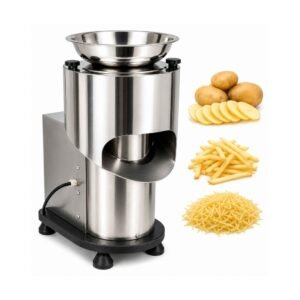
Potato Chips Machine 50 Kg
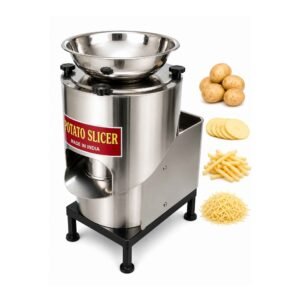
Potato Chips Machine 150 Kg
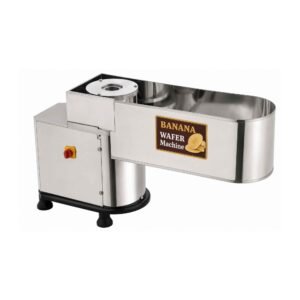
Banana Wafer Making Machine
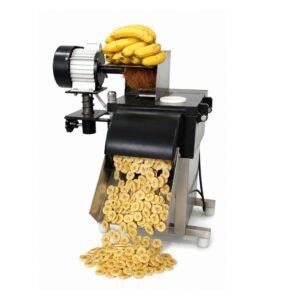
Automatic Banana Chips Making Machine
Key Points to Consider
- Potato chips production involves several connected processing stages.
- The equipment configuration depends on the required output and product specifications.
- Potato quality can influence slicing, frying, texture, and final appearance.
- A processing line can be designed with different levels of automation.
- Washing, peeling, slicing, dewatering, frying, seasoning, cooling, and packing are common operations.
- The fryer, conveyors, seasoning equipment, and packaging section should be appropriately matched to the intended production rate.
- Hygiene, cleaning access, operator safety, and routine maintenance should be considered during plant planning.
- A Potato Chips Plant Supplier In Kenya can assist in developing a machinery configuration around the buyer’s production requirements.
Contact Sri Brothers Enterprises today to discuss your Potato Chips Plant requirement and request a quotation.
Understanding a Potato Chips Processing Plant
A potato chips plant is an organized collection of machines used to process fresh potatoes into finished chips. Instead of performing each operation manually, commercial equipment allows different stages to be connected into a continuous or semi-continuous workflow.
The production line begins with raw potato preparation. Potatoes are cleaned and sorted before being peeled and cut into slices. Depending on the selected recipe and processing method, the slices may then pass through blanching and moisture-removal stages.
Prepared slices are cooked in a fryer and subsequently handled through seasoning and cooling operations. The finished product is then delivered to the packing section, where it can be packed into the required retail or bulk format.
The exact configuration can vary considerably. A small manufacturer may use selected semi-automatic equipment, while a larger operation may require an integrated continuous system with automated product transfer.
Therefore, there is no single machine combination that is suitable for every business. The plant should be developed around the actual production objective.
Potato Selection and Raw Material Preparation
The quality of the finished chips begins with the raw potatoes.
Potatoes intended for chip production should be evaluated for physical condition, size, moisture characteristics, starch behavior, and suitability for the intended processing method. Excessively damaged or unsuitable potatoes can create difficulties during peeling and slicing and may also affect the appearance of the final product.
Raw potatoes are generally received in a designated handling area. Sorting can remove unwanted material before the potatoes enter the main processing section.
For a commercial operation, consistent raw-material sourcing is important because significant changes in potato characteristics can affect machine performance and finished-product consistency.
A machinery supplier can provide guidance about the processing equipment, but the manufacturer should also establish appropriate raw-material specifications for its particular product.
Potato Washing Equipment
The first major machine in many processing lines is the potato washer.
Fresh potatoes can carry soil and other material from harvesting and transportation. Industrial washing equipment is designed to clean the surface before the potatoes move toward peeling and cutting.
The washer selected for a commercial plant should correspond to the required throughput. A mismatch between washing capacity and downstream machinery can create interruptions in the production flow.
Water usage, cleaning arrangements, drainage, machine construction, and accessibility should also be considered when designing this part of the facility.
For higher-output operations, continuous washing equipment can be integrated with conveyors to reduce manual movement between processing stages.
Potato Peeling Machine
After washing, the potatoes can enter an industrial peeling machine.
Mechanical peeling systems are designed to remove the outer skin efficiently while preparing the potato for slicing. Different machine designs may be available depending on capacity and processing requirements.
One important consideration is controlling product loss during peeling. Excessive removal of edible potato can increase raw-material consumption and reduce overall processing efficiency.
The peeling machine should therefore be selected according to the type and size of potatoes being processed, the desired output, and the operating method of the plant.
Potato Slicing Machine
The next stage is cutting the peeled potatoes into thin slices.
Slicing is a critical operation because chip thickness affects cooking behavior. If slices vary significantly in thickness, some pieces may cook faster than others, creating inconsistency in the finished product.
An industrial potato slicer is designed to produce repeated cuts at a controlled thickness. The appropriate machine depends on the intended chip style, production volume, and required processing speed.
Before purchasing a slicer, buyers should clarify the desired slice dimensions and verify that the machine is designed for the intended raw-material characteristics.
The slicing section should also be easy to inspect and clean because food particles can accumulate around processing components if cleaning is not performed correctly.
Blanching Stage
Some potato chips production methods include a blanching operation between slicing and frying.
Blanching involves controlled treatment of the sliced potatoes and can be used as part of the preparation process before cooking. Its exact purpose and operating parameters depend on the product formulation and manufacturing method.
Not every potato chips plant will use an identical blanching process. For this reason, buyers should define their intended recipe and processing procedure before finalizing equipment.
If blanching is required, the blancher should be selected according to the plant’s throughput and integrated into the material flow so that the slices can move efficiently toward the next operation.
Removing Excess Moisture
Moisture management is an important part of potato chips processing.
After washing or blanching, the potato slices can carry water on their surface. Removing excess moisture before frying can support better fryer operation and reduce unnecessary water entering the cooking system.
A dewatering machine or suitable moisture-removal arrangement can be positioned between preparation and frying.
The equipment should be selected according to the production rate so that it does not become a restriction in the overall processing line.
Industrial Potato Chips Fryer
The frying section is central to the manufacturing process.
A commercial fryer provides controlled heating for cooking potato slices in frying oil. Depending on the plant design, the fryer may operate continuously and move the product through the cooking zone at a controlled rate.
When evaluating frying equipment, manufacturers should consider:
- Required production capacity
- Heating arrangement
- Temperature control
- Oil circulation
- Product residence time
- Oil management
- Cleaning requirements
- Available energy source
- Operator safety
Frying conditions have a direct relationship with the finished product. Therefore, the fryer should be properly matched to the product formulation and upstream preparation process.
A Potato Chips Plant Supplier In Kenya should provide clear technical information about the proposed fryer rather than quoting only a general machine name.
Oil Management and Filtration
During repeated frying, small food particles can accumulate in the cooking oil. An appropriate oil-management arrangement can help remove unwanted particles from the frying system.
Filtration requirements depend on fryer design, production conditions, oil type, operating hours, and the manufacturing process.
For a commercial facility, oil handling should be considered during the initial plant design rather than treated as an afterthought. Proper access for inspection, cleaning, and maintenance can make day-to-day operation easier.
Seasoning System
Once the chips have been fried, seasoning can be applied according to the manufacturer’s product formulation.
A seasoning machine is designed to distribute ingredients such as salt or prepared flavoring blends over the chips. Uniform application is important when the company wants consistent flavor throughout its packaged products.
The seasoning system can be configured according to product volume and flavor requirements. Businesses producing multiple varieties should also consider product changeover and cleaning requirements.
For example, a manufacturer producing several flavors may require a system that allows efficient adjustment between different seasoning recipes.
Cooling the Finished Chips
Freshly cooked chips need suitable cooling before they enter final packaging.
A cooling conveyor or dedicated cooling arrangement can move the product while allowing its temperature to decrease. The cooling section should be coordinated with the frying and packing capacities.
If the cooling stage cannot handle the output of the fryer, product accumulation can occur. Likewise, excessive cooling capacity may add unnecessary equipment and floor-space requirements.
A balanced line therefore considers the output of each processing stage rather than selecting machines independently.
Potato Chips Packaging Machine
Packaging converts the processed chips into a market-ready product.
Depending on the manufacturer’s requirements, chips may be packed in different bag sizes and formats. Automatic packing equipment can be integrated with weighing, filling, sealing, and product-discharge functions.
The packaging system should be selected based on:
- Pack size
- Required production speed
- Product characteristics
- Packaging material
- Sealing requirements
- Desired automation
- Available floor space
Packaging is particularly important for snack products because the package needs to protect the chips during handling, transportation, storage, and retail distribution.
Main Machinery in a Potato Chips Plant
A complete plant may contain a combination of the following equipment:
- Potato receiving and sorting equipment
- Potato washing machine
- Potato peeling machine
- Potato slicing machine
- Blanching equipment
- Dewatering machine
- Continuous frying system
- Oil filtration equipment
- Seasoning machine
- Cooling conveyor
- Product transfer conveyors
- Packaging machine
- Electrical control system
The list should not be treated as a fixed specification for every project. Some businesses may require additional equipment, while others may use a simpler configuration.
The correct machinery list should be prepared after understanding production capacity, product formulation, automation requirements, and available utilities.
How to Choose a Potato Chips Plant Supplier In Kenya
Choosing a supplier involves evaluating technical capability as well as the equipment itself.
A suitable Potato Chips Plant Supplier In Kenya should be able to explain how individual machines work together within the proposed production line. The supplier should also provide understandable technical details about capacity, construction, power requirements, heating requirements, dimensions, and operating conditions.
Buyers should avoid making a decision solely from a machine photograph or a basic price quotation. Two machines with similar appearances can have different operating capacities, components, controls, and construction details.
A detailed technical quotation makes it easier to compare different proposals and identify what is actually included.
Production Capacity Planning
Production capacity should be established before machinery is finalized.
For example, a business supplying a limited number of retail outlets may have different requirements from a manufacturer distributing packaged chips through a larger network.
Capacity planning should consider:
- Expected daily production
- Operating hours
- Raw potato availability
- Required finished-product output
- Packaging speed
- Workforce
- Available space
- Utility capacity
- Future expansion
It is also important to distinguish between the nominal capacity of an individual machine and the practical output of the complete line.
The overall production rate can be restricted by the slowest or most capacity-limited stage. A well-integrated plant attempts to maintain a suitable balance between preparation, frying, seasoning, cooling, and packaging.
Automatic and Semi-Automatic Plant Options
Automation can be adjusted according to the needs of the business.
A semi-automatic potato chips line may involve operators at selected points. This can provide flexibility for businesses with moderate output requirements or those gradually developing their production operation.
An automated plant can connect several stages using conveyors, control systems, and continuous processing equipment. This reduces repetitive manual intervention and can make production flow more consistent.
Neither configuration should be selected simply because it is more automated. The appropriate choice depends on output requirements, investment, workforce availability, operating model, and expansion plans.
Hygiene and Food-Contact Construction
Hygienic equipment design is essential in food processing.
Machines should provide practical access for cleaning and inspection, especially around areas where potato pieces, oil, water, or seasoning material may accumulate.
Food-contact components should be selected according to the intended application and applicable requirements. Buyers should request construction and material information from the supplier before placing an order.
The surrounding plant layout is equally important. Adequate space should be provided for operators, cleaning activities, inspection, maintenance, and safe movement around machinery.
Utility Requirements
A potato chips processing facility requires appropriate infrastructure.
Depending on the selected machinery, utilities may include electricity, water, heating fuel, drainage, ventilation, and compressed air.
The exact requirements depend on the equipment configuration. For example, the fryer may have different energy requirements depending on its heating arrangement.
Before equipment delivery, the buyer should receive the necessary utility information so that the production facility can be prepared properly.
Installation and Technical Support
Installing a complete processing line involves more than placing machines on the floor.
Equipment may need to be aligned and connected with conveyors, electrical systems, water supply, drainage, heating arrangements, controls, and other supporting components.
Installation guidance can help reduce errors during commissioning. Operators should also receive suitable instructions for starting, stopping, cleaning, and maintaining the machinery.
When evaluating a Potato Chips Plant Supplier In Kenya, buyers should ask what technical assistance is available before and after commissioning.
Maintenance and Spare Parts
Regular maintenance helps keep processing equipment operating reliably.
Different machines require different maintenance procedures. Cutting assemblies, conveyors, bearings, electrical components, heating elements, fryer components, and sealing systems may all require periodic inspection.
Cleaning is also an important part of routine equipment care.
Before purchasing a plant, the buyer should ask about recommended maintenance schedules and commonly required spare parts. Knowing the availability and replacement procedure for important components can help with long-term production planning.
Custom Potato Chips Plant Solutions
A processing plant does not always have to follow a standard configuration.
A customized solution can be developed around the manufacturer’s available floor area, required output, product specifications, automation preference, packaging format, and utility infrastructure.
For example, a business with limited space may need a compact equipment arrangement, whereas a high-output operation may prioritize continuous processing and automated material transfer.
Customization should be discussed before the final quotation because changes to capacity or machine arrangement can affect the complete plant design.
Questions to Ask Before Ordering
Before selecting a Potato Chips Plant Supplier In Kenya, buyers can ask the following questions:
- What is the capacity of the complete processing line?
- Which machines are included in the quotation?
- What are the power requirements?
- What heating system is proposed for the fryer?
- What materials are used in food-contact areas?
- How is the line cleaned?
- What level of automation is included?
- What packaging formats can the proposed system handle?
- What spare parts are recommended?
- Is installation guidance available?
- What technical documents are supplied?
- Can the plant be expanded later?
- Can the machinery be customized according to available space?
Getting these details in writing makes equipment comparison more straightforward.
Planning for Future Expansion
A potato chips business may increase production as distribution expands. Future capacity should therefore be considered during the initial plant-planning stage.
Depending on the original design, expansion may involve adding packaging capacity, increasing frying capacity, upgrading automation, extending conveyors, or introducing additional seasoning options.
A scalable design can make future modifications easier. However, expansion should be technically evaluated because increasing one machine’s capacity may require corresponding changes elsewhere in the processing line.
Discussing long-term production plans with the supplier before ordering can help create a more suitable initial configuration.
Why Complete Line Integration Matters
Potato chips production is a chain of connected operations. The performance of one stage can influence the next.
Poorly matched equipment can result in accumulation between machines, inconsistent material flow, excessive manual intervention, or unused processing capacity.
For this reason, businesses should consider the entire production sequence when purchasing machinery. Washing, peeling, slicing, moisture removal, frying, seasoning, cooling, and packaging should be planned as parts of one workflow.
An experienced Potato Chips Plant Supplier In Kenya can use the buyer’s production requirements to develop a machinery arrangement that connects these stages appropriately.
Final Considerations for Potato Chips Manufacturing in Kenya
Setting up a potato chips plant requires careful evaluation of raw materials, processing methods, machinery, utilities, workforce, packaging, hygiene, and future production requirements.
The equipment should not be selected solely according to its appearance or advertised capacity. Buyers should examine the technical specifications of the complete line and determine whether the proposed machinery matches their actual manufacturing needs.
A well-planned facility can organize the journey of the potato from raw-material receiving through cleaning, peeling, slicing, preparation, frying, seasoning, cooling, and packaging.
For businesses searching for a Potato Chips Plant Supplier In Kenya, obtaining a detailed machinery proposal based on actual production requirements is an important starting point. The final plant configuration should provide an appropriate balance between capacity, automation, operating requirements, maintenance, and available infrastructure.
With suitable planning and correctly matched equipment, manufacturers can develop a potato chips processing setup designed around their particular business model and production objectives.
Frequently Asked Questions
A commercial line may use washing, peeling, slicing, blanching, dewatering, frying, oil filtration, seasoning, cooling, conveying, and packaging equipment. The final machinery combination depends on the required production process and capacity.
Yes. Machinery configurations can be developed for different output requirements. The equipment capacity should be matched across the complete processing sequence rather than based on one machine alone.
Raw potato characteristics, slice thickness, preparation method, moisture level, frying conditions, seasoning, cooling, and packaging can all influence the finished product.
No. The need for blanching depends on the selected manufacturing process, raw material, recipe, and desired product characteristics. The processing method should be finalized before choosing the equipment.
Important factors include production capacity, heating method, temperature control, oil management, product residence time, cleaning access, safety, and available utilities.
A suitable seasoning arrangement can allow manufacturers to produce different flavor variants. The practical setup depends on the seasoning equipment, recipes, cleaning procedure, and production schedule.
Consider expected sales, daily production requirements, operating hours, raw-material availability, packaging demand, and future growth. The capacity of individual machines should also be balanced across the complete line.
Yes. Food-processing machinery requires routine cleaning and inspection. Specific procedures should follow the equipment manufacturer's operating and maintenance instructions.
Plant configuration can be adapted according to capacity, available space, automation level, product requirements, utility conditions, and packaging needs.
Provide your desired production capacity, product type, expected operating hours, available floor area, preferred packaging format, automation requirements, and available utilities. This information helps the supplier prepare a more relevant machinery proposal.
Conclusion
A commercial potato chips plant brings together multiple processing stages to convert fresh potatoes into a packaged snack product. Every section, from raw-potato handling to final packing, needs to work as part of a coordinated production system.
Businesses in Kenya planning such a facility should evaluate machinery capacity, processing requirements, construction, hygiene, energy needs, automation, maintenance, technical assistance, and future expansion before making a purchasing decision.
Selecting a Potato Chips Plant Supplier In Kenya should therefore involve a detailed assessment of the complete processing solution rather than a simple comparison of machine prices. A properly planned line can be configured around the manufacturer’s required output, product characteristics, available infrastructure, and long-term business objectives.


Add a review
Your email address will not be published. Required fields are marked *