
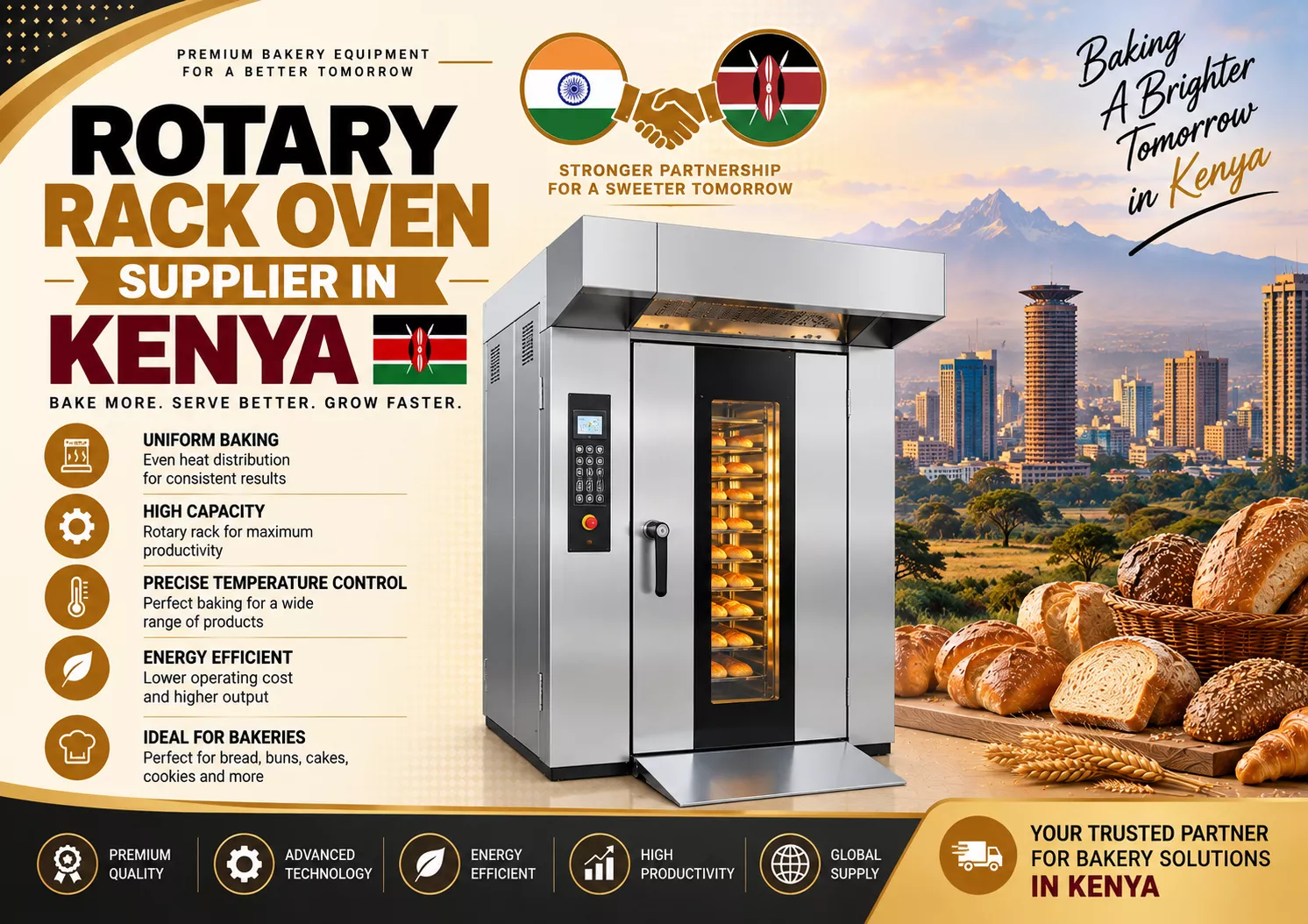
Rotary Rack Oven Supplier In Kenya
Choosing the right Rotary Rack Oven Supplier In Kenya is an important decision for commercial bakeries, bread manufacturers, hotels, supermarkets, restaurants, catering companies, institutional kitchens, and large-scale food-production facilities. A rotary rack oven is designed for high-volume baking, where consistent heat distribution, efficient batch production, steam control, and repeatable baking results are essential.
The Kenyan bakery-equipment market includes locally supplied rotary rack ovens in different capacities. Current Kenyan listings include single- and double-trolley rotary rack ovens, while other local bakery-equipment providers offer 16-, 32-, and 64-tray rotary oven configurations.
For businesses searching for a Rotary Rack Oven Supplier In Kenya, the purchase should not be based solely on machine price or tray count. Buyers should evaluate tray dimensions, trolley capacity, heating method, temperature control, steam system, baking capacity, electrical or fuel requirements, installation, maintenance, spare parts, warranty, and after-sales support.
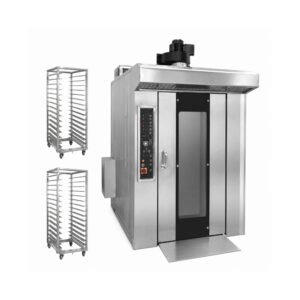
16 Tray Rotary Rack Oven
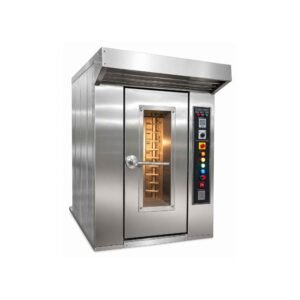
72 Tray Rotary Rack Oven
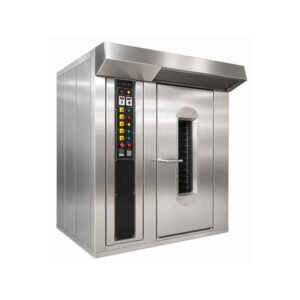
84 Tray Rotary Rack Oven
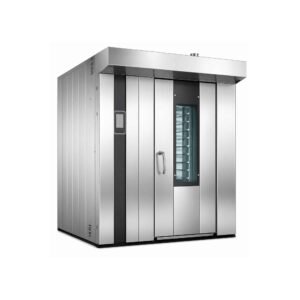
198 Tray Rotary Rack Oven
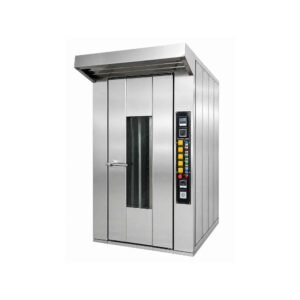
42 Tray Rotary Rack Oven
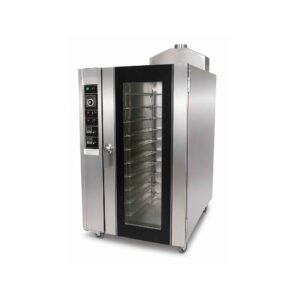
10 Tray Rotary Rack Oven
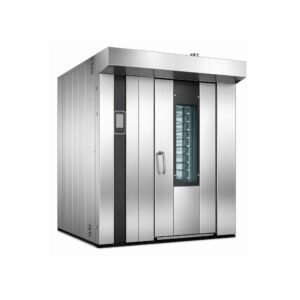
172 Tray Rotary Rack Oven
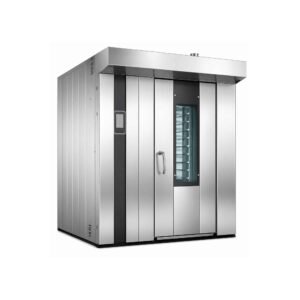
220 Tray Rotary Rack Oven
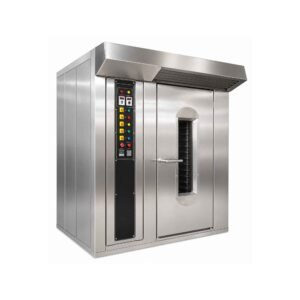
88 Tray Rotary Rack Oven
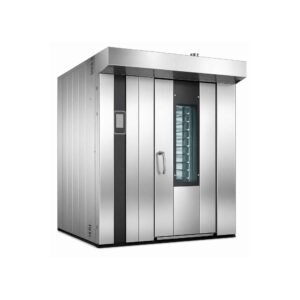
120 Tray Rotary Rack Oven
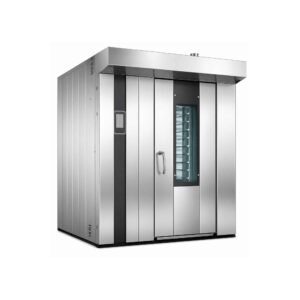
132 Tray Rotary Rack Oven
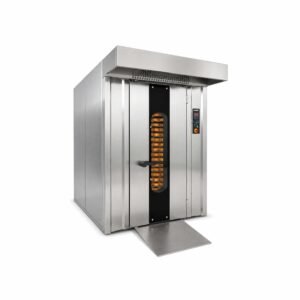
24 Tray Rotary Rack Oven
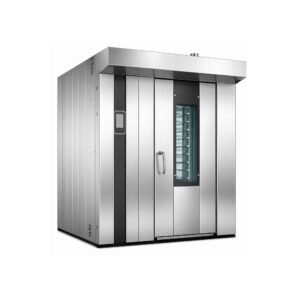
240 Tray Rotary Rack Oven
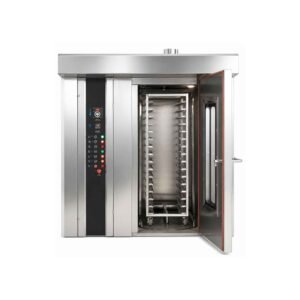
36 Tray Rotary Rack Oven
What Is a Rotary Rack Oven?
A rotary rack oven is a commercial baking oven designed to bake multiple trays of products simultaneously while a rack or trolley rotates inside the heated chamber.
The rotating rack exposes trays to the heated environment from different positions during the baking cycle. This helps improve heat exposure and can provide more consistent color, texture, and baking across a large batch.
Rotary rack ovens are particularly suitable for high-volume bakery production.
They can be used for:
- Bread
- Buns
- Rolls
- Baguettes
- Cakes
- Cookies
- Pastries
- Croissants
- Muffins
- Biscuits
- Specialty bakery products
A current Kenyan single-trolley model, for example, is specified for 18 trays measuring 600 × 800 mm, 36 trays measuring 400 × 600 mm, or 30 bread pans.
Contact Sri Brothers Enterprises today to discuss your rotary rack oven requirement and request a quotation.
How Does a Rotary Rack Oven Work?
The operating principle combines forced hot-air circulation with rack rotation.
The loaded trolley is positioned inside the baking chamber. Once the baking cycle begins, the heating system raises the chamber to the selected temperature while the rack rotates.
The general process is:
- Preheat the oven to the required temperature.
- Load prepared products onto trays.
- Position the trolley inside the baking chamber.
- Secure the trolley and close the oven door.
- Set the required temperature and baking time.
- Activate steam when the recipe requires it.
- Allow the rack to rotate during baking.
- Monitor the programmed baking cycle.
- Remove the trolley after the baking cycle is complete.
The combination of rotation and controlled heat circulation is particularly useful when many trays must be baked during a single production cycle.
Why Use a Rotary Rack Oven in Kenya?
A properly selected rotary rack oven can provide several operational advantages for commercial bakeries.
High Batch Capacity
A rotary rack oven can accommodate many trays in a single baking cycle, making it suitable for high-volume production.
Consistent Baking
Rack rotation and controlled heat circulation can help reduce variations between trays.
Efficient Production
Large batches can be processed without repeatedly loading individual deck ovens.
Steam Capability
Steam can be important for bread and certain bakery products because it can influence crust formation and product appearance.
Current Kenyan rotary rack oven listings include models with automatic steaming systems.
Flexible Product Range
A rotary rack oven can be used for different bakery products when appropriate baking temperatures, times, trays, and recipes are used.
Reduced Manual Handling
A trolley-based design can simplify loading and unloading compared with manually transferring individual trays into multiple static ovens.
Rotary Rack Oven Configurations Available in Kenya
Capacity should be selected according to actual production requirements.
Single-Trolley Rotary Rack Oven
A single-trolley system is suitable for many medium- and high-volume bakery operations.
A current Kenyan listing provides a single-trolley oven with:
- 18 trays of 600 × 800 mm
- 36 trays of 400 × 600 mm
- 30 bread pans
The same listing identifies automatic steaming and electric or fuel configurations as available features.
Double-Trolley Rotary Rack Oven
Double-trolley configurations can provide substantially greater production capacity for larger bakeries.
Kenyan commercial-equipment listings currently include Tombake double-trolley rotary rack ovens.
The actual number of trays and production capacity should be confirmed from the specific manufacturer’s technical documentation.
16-Tray Rotary Oven
A 16-tray configuration can be appropriate for bakeries requiring more capacity than a small convection oven but not needing a very large industrial system.
Kenyan bakery-equipment provider Bake Wave currently advertises a 16-tray rotary oven.
32-Tray Rotary Oven
A 32-tray system provides greater batch capacity and can be suitable for growing commercial bakeries.
Bake Wave currently lists a 32-tray rotary oven and describes it as part of its Kenyan bakery solutions.
64-Tray Rotary Oven
A 64-tray configuration is designed for significantly higher production requirements.
Current Kenyan listings include a 64-tray rotary oven, demonstrating that large-capacity rotary systems are available in the local market.
Electric vs Fuel-Fired Rotary Rack Oven
One of the most important decisions when selecting a Rotary Rack Oven Supplier In Kenya is the heating method.
Electric Rotary Rack Oven
Electric models can be suitable where the facility has adequate electrical infrastructure.
Potential advantages include:
- Precise temperature control
- Straightforward operation
- No direct combustion within the baking chamber
- Suitable for certain indoor installations
- Consistent heating
However, large electric ovens can have substantial connected electrical loads. The available electrical supply should therefore be checked before ordering.
Gas or Fuel-Fired Rotary Rack Oven
Fuel-fired systems may be appropriate for bakeries where the relevant fuel infrastructure is available.
Depending on the model, the heating system may use gas or another fuel source.
Before installation, confirm:
- Fuel type
- Fuel consumption
- Burner specification
- Required pressure
- Ventilation
- Exhaust
- Safety requirements
- Local installation requirements
Current Kenyan rotary oven offerings include models advertised with fuel or electric configurations. One local single-trolley listing specifically identifies electric or fuel execution as available.
Steam System
Steam is an important consideration for many bread-baking applications.
Steam introduced during the early stages of baking can affect:
- Crust development
- Surface appearance
- Product expansion
- Crust texture
Not every bakery product requires steam, so the correct system should be selected according to the product range.
When evaluating a Rotary Rack Oven Supplier In Kenya, ask whether the oven provides:
- Automatic steam injection
- Manual steam control
- Built-in steam generator
- External steam connection
- Steam timing control
A current Kenyan rotary rack oven listing specifies an automatic steaming system.
Tray Capacity and Production Planning
Tray count is one of the most visible specifications, but it should not be the only factor used to estimate production.
Actual output depends on:
- Tray dimensions
- Number of products per tray
- Product weight
- Product spacing
- Baking time
- Loading time
- Unloading time
- Product changeovers
- Daily operating hours
For example, a 36-tray oven using 400 × 600 mm trays will have a different production profile from a machine using 600 × 800 mm trays.
The current Kenyan single-trolley Tombake listing demonstrates this distinction by specifying both 18 × 600 × 800 mm trays and 36 × 400 × 600 mm trays.
Therefore, production capacity should be calculated from the actual tray format and product arrangement.
Bread Production Capacity
Some Kenyan suppliers market rotary ovens according to estimated bread output.
For example, Bake Wave currently advertises a 32-tray rotary oven at approximately 330 loaves per hour and provides larger 16-, 32-, and 64-tray rotary configurations.
These figures should be treated as supplier/model-specific capacity claims, not universal production rates.
Actual output can vary according to:
- Loaf weight
- Number of loaves per tray
- Tray arrangement
- Baking time
- Loading efficiency
- Bread recipe
- Cooling and packaging workflow
A professional supplier should calculate expected output using your actual bread specifications.
Key Specifications to Compare
When evaluating a Rotary Rack Oven Supplier In Kenya, compare the complete technical specification.
Specification | Details |
Oven Type | Single trolley, double trolley, or other configuration |
Tray Capacity | Total trays accommodated |
Tray Dimensions | Compatible tray sizes |
Bread Pan Capacity | Number and compatible pan format |
Heating Type | Electric, gas, diesel, or other specified fuel |
Temperature Range | Minimum and maximum operating temperature |
Temperature Control | Digital, electronic, or programmable |
Heating System | Burner or electric heating elements |
Air Circulation | Forced hot-air circulation system |
Rack Rotation | Motorized rotating rack |
Steam System | Automatic, manual, integrated, or external |
Steam Control | Timing and injection control |
Control Panel | Digital or electronic controls |
Baking Timer | Manual, digital, or programmable |
Motor Power | Heating and rotation motor ratings |
Electrical Supply | Voltage, phase, and frequency |
Fuel Requirement | Type and consumption where applicable |
Insulation | Chamber and body insulation |
Chamber Construction | Stainless steel or specified material |
Door Construction | Insulated commercial oven door |
Trolley System | Compatible trolley configuration |
Machine Dimensions | Overall footprint and height |
Machine Weight | Installed equipment weight |
Safety System | Door, burner, temperature, and electrical protection |
Installation | Delivery, positioning, connection, and commissioning |
Warranty | Coverage period and conditions |
Spare Parts | Availability and lead time |
Service | Maintenance and technical support |
The exact values should always be confirmed from the manufacturer’s technical datasheet.
Example of a Current Kenyan Rotary Rack Oven Specification
A current Kenyan listing for a Tombake single-trolley rotary rack oven provides a useful example of how detailed specifications can differ by model.
The listed machine includes:
- 18 trays of 600 × 800 mm
- 36 trays of 400 × 600 mm
- 30 bread pans
- Automatic steaming
- Electric or fuel configuration
- 6.5 kW listed power
- 220–240 V, 50–60 Hz
- Approximately 1,150 kg weight
- Dimensions of approximately 190 × 128 × 247 cm
These figures describe that particular listed model and should not be treated as specifications for every rotary rack oven.
Applications of Rotary Rack Ovens in Kenya
Commercial Bakeries
Rotary rack ovens are suitable for high-volume production of bread, rolls, pastries, cakes, and other bakery products.
Bread Manufacturing
Large bread producers can use rotary rack ovens as part of a continuous production workflow.
Hotels
Hotels can use rotary rack ovens in central bakery departments and large food-production kitchens.
Supermarkets
Supermarket bakeries can use rotary ovens for fresh bread and pastry production.
Catering Companies
Catering operations can benefit from large batch capacity when preparing products for events.
Institutional Kitchens
Schools, hospitals, universities, and other institutions with large food-production requirements may use commercial bakery equipment.
Central Bakeries
Central production facilities can integrate rotary rack ovens with complete bakery lines.
A typical production line may include:
Flour Handling → Spiral Mixer → Dough Divider → Dough Moulder → Proofer → Rotary Rack Oven → Cooling → Bread Slicer → Packaging
Kenyan bakery-equipment providers also advertise complete bakery solutions incorporating mixers, dividers, moulders, proofers, ovens, and slicers.
How to Choose the Right Rotary Rack Oven Supplier in Kenya
Just as important as selecting the machine is selecting the supplier.
Technical Consultation
The supplier should understand your:
- Daily production
- Product range
- Tray dimensions
- Bread weight
- Baking temperature
- Baking time
- Fuel availability
- Electrical infrastructure
- Available floor space
Production Calculation
A supplier should calculate the required oven capacity rather than simply recommending the largest machine available.
Installation Support
Large rotary ovens require proper positioning, connection, commissioning, and testing.
Operator Training
Operators should understand:
- Preheating
- Loading
- Temperature programming
- Steam operation
- Rack rotation
- Baking cycles
- Cleaning
- Safety procedures
Spare Parts
Ask about the availability of:
- Heating elements
- Burners
- Motors
- Bearings
- Door seals
- Sensors
- Controllers
- Steam components
- Rotation components
- Electrical parts
Maintenance
Preventive maintenance can help reduce downtime and preserve consistent baking performance.
Local Bakery Equipment Support in Kenya
Kenya has an established commercial bakery-equipment ecosystem, particularly in Nairobi.
Current local listings include Bake Wave Ltd, which operates on Mombasa Road and advertises rotary ovens, and Nairobi Kitchen Care Ltd, whose bakery-equipment range includes single- and double-trolley rotary rack ovens.
Uni Industries East Africa Ltd and BakeKing Solutions are among other Nairobi-area businesses categorized for bakery equipment.
There are also Kenya-based service providers offering rotary rack oven fabrication, installation, commissioning, and repairs. For example, HomeTech Kenya states that it provides rotary rack oven fabrication, installation, and repair services across Nairobi and countrywide.
For a bakery purchasing expensive production equipment, this local service ecosystem makes installation and maintenance capability an important part of supplier evaluation.
Installation Requirements in Kenya
Before purchasing a rotary rack oven, the site should be assessed carefully.
Electrical Requirements
For electric models, confirm:
- Voltage
- Phase
- Frequency
- Connected load
- Breaker requirements
- Cable requirements
- Earthing
Do not assume that the existing bakery electrical system can support the oven.
Fuel Requirements
For fuel-fired models, confirm:
- Fuel type
- Fuel consumption
- Burner requirements
- Fuel pressure
- Storage requirements where applicable
- Ventilation
- Exhaust
- Safety systems
Ventilation and Exhaust
Commercial baking generates heat, moisture, and combustion gases where applicable.
The kitchen should therefore have an appropriately designed ventilation and exhaust system.
Floor Space
Provide sufficient space for:
- Oven doors
- Trolley movement
- Loading
- Unloading
- Cleaning
- Maintenance
- Service access
Delivery Access
Large rotary ovens can be difficult to move through restricted spaces.
Check:
- Entrance dimensions
- Door width
- Corridor clearance
- Elevator dimensions
- Elevator load capacity
- Loading area
- Final installation route
Maintenance of a Rotary Rack Oven
Regular maintenance is essential for reliable bakery production.
Recommended maintenance practices include:
- Clean the baking chamber regularly.
- Remove crumbs and food residues.
- Inspect door seals.
- Check temperature sensors.
- Inspect heating elements.
- Service burners according to manufacturer requirements.
- Inspect rack rotation components.
- Check trolley wheels and alignment.
- Inspect bearings and drive components.
- Check steam components.
- Inspect control-panel operation.
- Check safety systems.
- Clean ventilation and exhaust components.
- Schedule preventive servicing.
Maintenance intervals should follow the manufacturer’s recommendations.
Common Mistakes When Buying a Rotary Rack Oven
Choosing Only by Tray Count
More trays do not automatically mean better production efficiency.
Ignoring Tray Dimensions
A 36-tray oven can have a very different usable production area depending on tray dimensions.
Ignoring Utility Infrastructure
Electrical and fuel requirements should be confirmed before ordering.
Buying Excess Capacity
An oversized oven can increase capital cost, energy use, and unused capacity.
Buying Insufficient Capacity
An undersized oven can create production bottlenecks.
Ignoring Steam Requirements
Bread products may require steam for the desired crust and appearance.
Not Planning Trolley Movement
The bakery layout must provide adequate space to load and move trolleys.
Ignoring After-Sales Service
A rotary rack oven is a major production asset, so spare parts and technical support are important.
Comparing Only Purchase Prices
Installation, energy use, maintenance, spare parts, warranty, and service should be considered when comparing total ownership costs.
Rotary Rack Oven Price in Kenya
The price of a rotary rack oven in Kenya depends on its capacity, heating method, tray configuration, automation, construction, brand, and included services.
Current Kenyan listings provide examples of the variation.
Bake Wave currently lists a 32-tray rotary oven at KSh 3,712,000 after a displayed discount from KSh 4,356,000.
Other 16- and 64-tray models are available through the same Kenyan supplier on a quotation basis.
These figures are specific current listings, not universal market prices. Actual quotations can vary depending on:
- Tray capacity
- Fuel system
- Steam system
- Automation
- Burner
- Electrical configuration
- Trolley configuration
- Installation
- Delivery
- Warranty
- Spare parts
- After-sales service
For a useful comparison, request quotations based on the same technical configuration.
Why Local Support Matters
Working with a Rotary Rack Oven Supplier In Kenya with local technical support can simplify:
- Delivery
- Installation
- Commissioning
- Operator training
- Troubleshooting
- Spare-parts procurement
- Preventive maintenance
- Emergency repairs
This is especially important for commercial bakeries where an oven breakdown can interrupt an entire production line.
A Kenya-based supplier or service partner can also understand local electrical, fuel, installation, and operating conditions better than a supplier with no local support structure.
What Makes a Reliable Rotary Rack Oven Supplier?
A professional Rotary Rack Oven Supplier In Kenya should demonstrate the four core E-E-A-T principles.
Experience
The supplier should understand commercial bakery production and the practical challenges involved in high-volume baking.
Expertise
Technical expertise is required to calculate:
- Required tray capacity
- Baking chamber size
- Production output
- Electrical load
- Fuel requirements
- Steam requirements
- Ventilation
- Installation requirements
Authority
A credible supplier should provide:
- Technical datasheets
- Manufacturer documentation
- Operating instructions
- Safety information
- Warranty details
- Installation information
- Spare-parts information
Trust
Trust comes from accurate specifications, transparent quotations, realistic delivery information, clear warranty conditions, and dependable after-sales service.
A professional supplier should recommend the oven according to the bakery’s actual production requirements rather than simply recommending the highest-capacity model.
Questions to Ask Before Ordering
Before purchasing from a Rotary Rack Oven Supplier In Kenya, ask:
- How many trays can the oven accommodate?
- What tray dimensions are supported?
- What bread-pan configurations are available?
- What is the actual baking capacity?
- What is the expected output per hour?
- Is the oven electric or fuel-fired?
- What fuel is required?
- What is the electrical load?
- What voltage, phase, and frequency are required?
- Is automatic steam included?
- What is the steam capacity?
- Is rack rotation automatic?
- What is the temperature range?
- Is the control system digital?
- Is a trolley included?
- Are additional trolley configurations available?
- What space is required around the oven?
- Is installation included?
- What spare parts are available locally?
- What warranty and after-sales support are provided?
These questions help buyers compare equipment based on actual production requirements.
Frequently Asked Questions
A rotary rack oven is used for high-volume baking of bread, rolls, buns, pastries, cakes, cookies, and other bakery products. It uses a rotating rack to expose multiple trays to controlled heat during a baking cycle.
The correct oven depends on daily production, product type, tray dimensions, required output, heating source, available utilities, and floor space. A supplier should calculate the required capacity based on the bakery's actual production.
Current Kenyan listings include 16-, 32-, and 64-tray rotary oven configurations, as well as a single-trolley oven specified for 18 trays of 600 × 800 mm or 36 trays of 400 × 600 mm.
They serve different production requirements. A rotary rack oven is designed for high-volume multi-tray baking, while deck ovens provide separate baking chambers and can be particularly useful for products requiring direct deck heat. The appropriate choice depends on the bakery's products, volume, space, and workflow.
Not every bakery product requires steam, but steam can be valuable for bread production. Many commercial rotary rack ovens therefore offer automatic or integrated steam systems.
Both configurations can be appropriate. The decision depends on electrical capacity, fuel availability, operating requirements, installation conditions, and the specific oven design.
Prices vary considerably according to capacity and configuration. A current Kenyan listing shows a 32-tray rotary oven at KSh 3,712,000, while other configurations are quotation-based. This should be treated as a current model-specific listing rather than a universal market price.
Consider technical expertise, tray capacity, production calculation, installation, commissioning, spare-parts availability, warranty, maintenance, operator training, and local technical support.
Yes. Rotary rack ovens can be used for bread, buns, rolls, cakes, cookies, pastries, and other bakery products when the oven's temperature, airflow, steam, trays, and baking cycle are suitable for the product.
A single-trolley oven is designed around one baking trolley, while a double-trolley system provides greater batch capacity. The exact tray count and production output depend on the specific machine configuration.
Conclusion
Choosing the right Rotary Rack Oven Supplier In Kenya requires careful evaluation of production capacity, tray dimensions, heating technology, steam capability, utility requirements, installation, and after-sales support.
The right rotary rack oven should match the bakery’s daily production volume, product range, tray format, bread weight, baking cycle, available electrical or fuel infrastructure, kitchen space, and future expansion plans.
A reliable Rotary Rack Oven Supplier In Kenya should provide more than equipment. The supplier should offer technical consultation, capacity planning, installation, commissioning, operator training, spare parts, preventive maintenance, warranty support, and responsive technical service.
Before purchasing, compare tray capacity, trolley configuration, heating system, temperature control, steam system, production output, electrical or fuel requirements, construction quality, safety features, installation requirements, warranty, and spare-parts availability.
For a smaller commercial bakery, a compact rotary configuration may be sufficient. Growing bakeries may require 32- or 36-tray systems, while large production facilities may need 64-tray or double-trolley configurations.
The most suitable machine is therefore not necessarily the largest or least expensive oven. It is the rotary rack oven that provides the appropriate combination of baking consistency, production capacity, energy efficiency, reliability, serviceability, and long-term operating value.

Add a review
Your email address will not be published. Required fields are marked *