
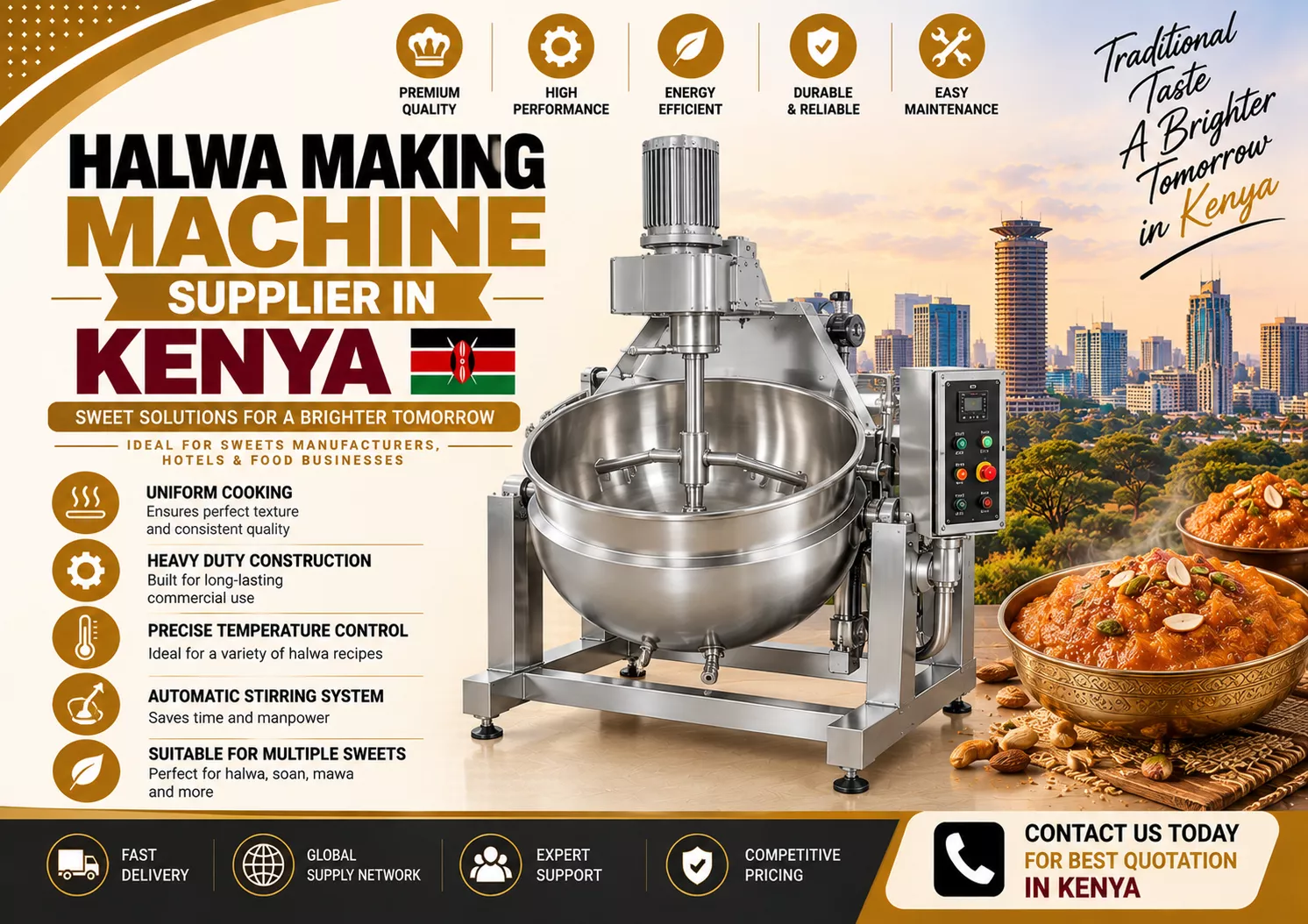
Halwa Making Machine Supplier In Kenya
A Halwa Making Machine Supplier In Kenya provides commercial equipment for businesses that need to prepare halwa in larger quantities with controlled mixing and cooking. Halwa production can involve roasting, heating, blending, moisture reduction and continuous stirring, depending on the recipe. When these activities are performed manually, the process can become tiring and difficult to repeat consistently as production increases.
Traditional preparation could still be useful for a candy store producing a few batches. But when a business supplies several outlets, handles catering orders, operates a hotel kitchen or manufactures sweets commercially, manual stirring can become a major part of the workload.
A dedicated halwa machine is designed to take over much of this repetitive work. The machine can combine a cooking vessel with a motor-driven mixing system and a heating arrangement. Some models also include tilting mechanisms that make unloading easier after the batch is finished.
The correct machine, however, depends on the recipe, batch size, production schedule and available utilities. A business should understand these points before selecting equipment.
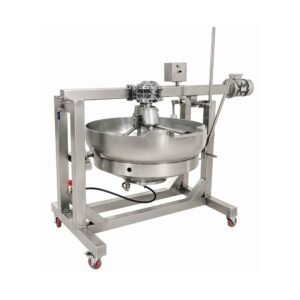
Halwa Making Machine 150 Kg
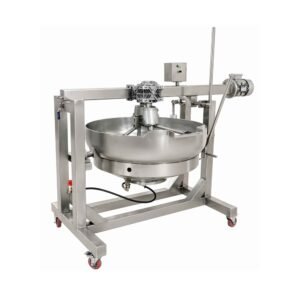
Halwa Making Machine 100 Kg
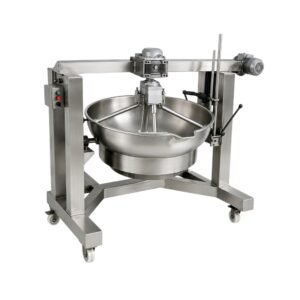
Halwa Making Machine
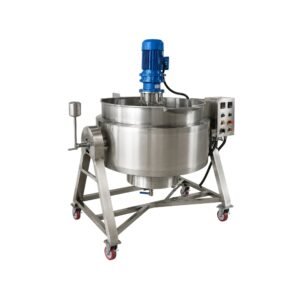
Halwa Making Machine 300 Kg
Start With the Type of Halwa You Plan to Make
The word “halwa” covers many different products.
A business may produce sooji halwa, atta halwa, besan halwa, gajar halwa, moong dal halwa or other regional recipes. Each preparation can have a different consistency and cooking behaviour.
For example, a mixture containing a high amount of sugar may become sticky during cooking. A vegetable-based halwa may release moisture for a different period. A roasted flour-based recipe may require controlled mixing from an early stage.
This means the equipment should be selected according to the product rather than simply according to the machine name.
Before contacting a Halwa Making Machine Supplier In Kenya, prepare a list of the products you expect to manufacture. Explain whether you need one recipe or several recipes on the same machine.
This information helps determine the appropriate pan, mixer, heating arrangement and working capacity.
Contact Sri Brothers Enterprises today to discuss your Halwa Making Machine requirement and request a quotation.
What Commercial Halwa Preparation Actually Requires
Making halwa at commercial scale is a combination of heat and mechanical movement.
Ingredients must remain in contact with the heated surface long enough for the desired cooking stage to develop. At the same time, the mixture must move so that one section does not remain exposed to excessive heat.
As the product thickens, the resistance against the mixing system increases. This is particularly important because a mixer that works well with a thin mixture may not perform the same way when the product becomes dense.
Commercial halwa machines therefore use stronger mechanical arrangements than ordinary kitchen mixers.
Some machines use heavy-duty blades, while others use scraper-type systems that continuously move the mixture across the cooking surface.
Why the Mixing System Deserves Attention
When comparing equipment, many buyers look first at the pan dimensions.
The mixing mechanism deserves equal attention.
A good mixing system should move the material throughout the working area without leaving large portions stationary. It should also be strong enough to handle the increasing thickness of the product.
A Halwa Making Machine Supplier In Kenya should be able to explain:
- Motor power
- Gearbox arrangement
- Mixing speed
- Blade or scraper design
- Direction of movement
- Food-contact material
- Replacement-part availability
Commercial machines are available with different motor sizes according to their working dimensions and capacity. The correct motor is not necessarily the one with the highest horsepower; it should be appropriate for the load.
This is especially important when producing thick halwa repeatedly during a working shift.
Pan Design Influences the Cooking Process
The cooking vessel is another major component.
A suitable pan needs enough working area for the ingredients to spread and mix properly. The shape and depth can influence how easily the mixture circulates.
Some commercial models are offered in different pan sizes, such as 2-foot, 3-foot, 4-foot and 5-foot configurations. Capacity can vary substantially between these models.
A Halwa Making Machine Supplier In Kenya should clarify whether the stated capacity refers to the normal working load or the maximum amount the vessel can physically hold.
This distinction matters because a machine should not be operated continuously at an unsuitable load simply because the vessel has enough physical space.
Batch Size Should Come From Your Daily Production
There is no universal machine capacity that suits every business.
Consider three different examples.
A small sweet shop may need only a modest quantity every morning.
A catering company may require several batches before a large event.
A manufacturing business may need repeated production throughout the day.
All three businesses make halwa, but their machinery requirements are completely different.
Before ordering, calculate:
Daily requirement → average batch → number of batches → available production hours
Then consider future growth.
If a business expects demand to double within a short period, choosing a machine that is already close to its maximum working load may create another equipment problem later.
A Halwa Making Machine Supplier In Kenya can use this information to recommend a more suitable configuration.
Heating Should Match the Production Environment
Heating is not simply about making the pan hot.
The heating arrangement should provide suitable heat across the cooking surface while allowing the operator to control the cooking process.
Commercial machines may be supplied with gas or electric heating, while larger industrial systems can use other heating arrangements depending on the process design.
The buyer should therefore check the utilities available at the installation site.
Important questions include:
- Is LPG available?
- Is the electrical supply sufficient?
- Is three-phase power available if required?
- Is ventilation adequate?
- Is additional gas infrastructure needed?
- Is there sufficient space around the heating system?
A Halwa Making Machine Supplier In Kenya should receive these details before final machine selection.
Selecting the machine first and checking the utility requirements afterward can create unnecessary installation difficulties.
Controlled Heat Can Improve Batch Repeatability
Halwa is sensitive to changes in the cooking process.
If one batch receives substantially more heat than another, the colour, moisture and texture can change.
Some commercial machines include adjustable heating or temperature-control systems. These features can help the operator manage the cooking process more consistently.
However, temperature control alone does not guarantee identical results.
The ingredients, quantities, starting temperature, cooking time and final stopping point also need to remain consistent.
For commercial production, businesses can create a simple batch sheet recording:
- Ingredient quantities
- Heating setting
- Mixing setting
- Cooking time
- Final product condition
- Finished batch weight
This turns individual experience into a repeatable production method.
Tilting Can Make Unloading Easier
Once halwa is ready, removing it from the vessel can become difficult because of its weight and sticky consistency.
A tilting mechanism allows the cooking vessel to move toward the discharge side. This can make it easier to transfer the finished product into trays, containers or the next production stage.
Commercial halwa machines are available with tilting arrangements.
A Halwa Making Machine Supplier In Kenya can explain whether tilting is appropriate for the customer’s batch size.
For a small machine, manual unloading may not be a major problem. For larger batches, tilting can reduce physical effort and improve the speed of product transfer.
Food-Contact Material Should Be Clearly Specified
The surfaces that touch the product need to be suitable for food processing.
Stainless steel is widely used in commercial sweet-making equipment, and manufacturers offer machines with stainless-steel bodies and food-contact components. Some models specifically list SS304 construction.
However, buyers should request the exact material specification instead of accepting a general statement such as “stainless body.”
Ask which material is used for:
- Cooking pan
- Mixing blade
- Scraper
- Product outlet
- Internal surfaces
- Covers
- Supporting components
A smooth and accessible food-contact area can also make routine cleaning easier.
Cleaning Is Part of Production
Halwa contains ingredients that can stick to surfaces during cooking.
If residue remains inside the vessel or around the mixing components, it can affect the next batch and make sanitation more difficult.
For this reason, the cleaning procedure should be considered before buying the machine.
Ask the Halwa Making Machine Supplier In Kenya:
- How is the pan cleaned?
- Can mixing components be accessed easily?
- Can residue be removed without damaging the surface?
- Are any parts removable?
- How should electrical components be protected during cleaning?
- What maintenance is required after washing?
The machine should fit into the daily cleaning routine rather than creating a separate maintenance problem.
A Machine Should Reduce Repetitive Labour
One of the practical reasons businesses invest in halwa equipment is to reduce continuous manual stirring.
An operator may still need to load ingredients, monitor the process, adjust settings and inspect the final product. The machine does not eliminate human supervision.
Instead, it changes the operator’s role.
Rather than spending the entire cooking cycle physically stirring the mixture, the operator can monitor the batch while the mechanical system performs the repetitive movement.
This can become particularly valuable when several batches are produced during the same shift.
A Halwa Making Machine Supplier In Kenya should explain which operations are automated and which still require operator involvement.
Automatic Does Not Mean Completely Unattended
The word “automatic” can mean different things in machinery advertising.
One machine may automate stirring.
Another may automate heating control.
A more advanced system may combine mixing, temperature control and other process functions.
Therefore, ask the supplier to explain exactly what the control panel operates.
For example:
Mixing automation: Does the motor run continuously or according to a programmed cycle?
Heating control: Can the operator adjust the heat?
Temperature monitoring: Is there a temperature display or sensor?
Tilting: Is the pan manually or mechanically tilted?
Safety: What protection is provided for the motor and electrical controls?
A clear explanation prevents misunderstandings during purchasing.
Choosing Between Small and Large Production Equipment
A business should consider its actual operating pattern.
If production is irregular, a smaller machine may be practical.
If production occurs every day, a stronger commercial model may be more suitable.
If the business supplies multiple locations, a larger batch system or multiple machines may be considered.
The decision should also include future demand.
A Halwa Making Machine Supplier In Kenya can compare different machine sizes based on the expected production schedule rather than simply offering the biggest available model.
The goal is to maintain a sensible relationship between production demand and equipment capacity.
Halwa Machines for Sweet Shops
Sweet shops are one of the most direct applications for this type of equipment.
A shop may produce different halwa varieties depending on customer demand and season. During festivals or special occasions, production can increase significantly.
A commercial machine can help the shop organise its production into planned batches.
Instead of preparing every batch entirely by hand, the business can establish a standard procedure for ingredient loading, cooking, mixing and unloading.
This can make staff training easier because the production process becomes more structured.
Halwa Machines for Hotels and Restaurants
Hotels and restaurants may have different requirements.
They may prepare halwa as part of a dessert menu rather than producing it as their main business.
In such cases, the equipment should fit the kitchen’s available space and daily production.
A very large industrial machine may not be practical for a hotel kitchen that only needs a limited quantity.
A Halwa Making Machine Supplier In Kenya should therefore ask about the customer’s kitchen size, daily requirement and number of operators before recommending equipment.
Halwa Machines for Catering Businesses
Large-scale halwa manufacturing may require more than one machine.
Industrial systems can separate cooking, mixing, transfer, cooling, forming and packaging into different stages.
For example, specialised halwa lines can include cooking tanks, whisking sections, conveyors, cooling systems and forming equipment for packaged products.
This type of setup is suitable for businesses producing standardised packaged products at significantly higher volumes.
A Halwa Making Machine Supplier In Kenya should first determine whether the customer wants a standalone cooking machine or a complete production line.
The investment, floor space and utility requirements can be very different.
Industrial Halwa Production Is a Different Category
Large-scale halwa manufacturing may require more than one machine.
Industrial systems can separate cooking, mixing, transfer, cooling, forming and packaging into different stages.
For example, specialised halwa lines can include cooking tanks, whisking sections, conveyors, cooling systems and forming equipment for packaged products.
This type of setup is suitable for businesses producing standardised packaged products at significantly higher volumes.
A Halwa Making Machine Supplier In Kenya should first determine whether the customer wants a standalone cooking machine or a complete production line.
The investment, floor space and utility requirements can be very different.
Product Consistency Depends on the Recipe Too
Machinery can improve mechanical consistency, but the recipe still needs to be controlled.
Suppose one operator uses more water and another uses less. Even with the same machine, the two batches may finish differently.
The same applies to sugar, ghee, flour, milk and other ingredients.
A commercial producer should therefore standardise:
- Ingredient weights
- Ingredient sequence
- Heating procedure
- Mixing procedure
- Cooking duration
- Final texture
- Cooling method
This creates a stronger production system than relying only on machine automation.
Halwa Machines for Hotels and Restaurants
Hotels and restaurants may have different requirements.
They may prepare halwa as part of a dessert menu rather than producing it as their main business.
In such cases, the equipment should fit the kitchen’s available space and daily production.
A very large industrial machine may not be practical for a hotel kitchen that only needs a limited quantity.
A Halwa Making Machine Supplier In Kenya should therefore ask about the customer’s kitchen size, daily requirement and number of operators before recommending equipment.
Halwa Machines for Catering Businesses
Catering businesses often face changing order volumes.
One day may require a small quantity, while another event may require multiple large batches.
A machine that supports repeatable batch production can help the caterer manage these changes.
The business should calculate its largest regular order rather than buying equipment only according to an occasional peak requirement.
If exceptionally large orders happen only a few times each year, additional production planning may be more economical than permanently operating an oversized machine.
Industrial Halwa Production Is a Different Category
Large-scale halwa manufacturing may require more than one machine.
Industrial systems can separate cooking, mixing, transfer, cooling, forming and packaging into different stages.
For example, specialised halwa lines can include cooking tanks, whisking sections, conveyors, cooling systems and forming equipment for packaged products.
This type of setup is suitable for businesses producing standardised packaged products at significantly higher volumes.
A Halwa Making Machine Supplier In Kenya should first determine whether the customer wants a standalone cooking machine or a complete production line.
The investment, floor space and utility requirements can be very different.
Product Consistency Depends on the Recipe Too
Machinery can improve mechanical consistency, but the recipe still needs to be controlled.
Suppose one operator uses more water and another uses less. Even with the same machine, the two batches may finish differently.
The same applies to sugar, ghee, flour, milk and other ingredients.
A commercial producer should therefore standardise:
- Ingredient weights
- Ingredient sequence
- Heating procedure
- Mixing procedure
- Cooking duration
- Final texture
- Cooling method
This creates a stronger production system than relying only on machine automation.
Plan the Area Before the Machine Arrives
The installation location should be prepared before delivery.
Measure the entrance through which the machine will be brought into the facility. Then measure the available working area.
Also consider the space required for:
- Ingredient loading
- Operator movement
- Machine tilting
- Product unloading
- Cleaning
- Maintenance
- Finished-product handling
A Halwa Making Machine Supplier In Kenya should provide machine dimensions and utility requirements before the final installation.
This is especially important for larger models because their physical dimensions and weight can make movement more difficult.
Electrical and Fuel Requirements
Never assume that the machine can simply be connected after arrival.
Confirm the required voltage, phase, motor power and electrical protection.
If gas heating is selected, confirm the required gas arrangement and ventilation.
If a machine uses a combination of electrical controls and gas heating, both systems need to be considered during installation.
A Halwa Making Machine Supplier In Kenya should provide these requirements clearly so the customer can prepare the site in advance.
Maintenance Should Be Planned From Day One
Regular inspection can help identify small problems before they become production interruptions.
The operator should monitor:
- Motor noise
- Gearbox condition
- Mixing performance
- Blade or scraper wear
- Heating performance
- Temperature controls
- Electrical connections
- Fasteners
- Tilting mechanism
- Product-contact surfaces
The manufacturer’s maintenance instructions should be followed for lubrication, component replacement and servicing.
A business should also keep commonly required spare parts available when practical.
Spare Parts and After-Sales Support
A machine is a long-term production asset, so support matters.
Before purchasing, ask the supplier about the availability of motors, gearboxes, blades, scrapers, bearings, switches, sensors and other components used by the selected model.
Ask how technical problems will be handled if the machine is being supplied internationally.
A Halwa Making Machine Supplier In Kenya should be able to explain warranty coverage, technical assistance and spare-parts arrangements.
This information can be as important as the initial machine price.
How to Compare Machine Quotations
Do not compare suppliers using price alone.
A useful comparison should include:
Working capacity – How much product is the machine designed to process?
Motor and gearbox – Are they suitable for thick mixtures?
Heating system – What energy source does the machine use?
Construction – What material is used for product-contact areas?
Mixing system – What type of blades or scrapers are fitted?
Discharge system – Is tilting included?
Controls – What functions are automated?
Cleaning – How easily can the product-contact areas be accessed?
Warranty – Which components are covered?
Support – What assistance is available after installation?
This creates a more realistic comparison between different machines.
What Information Should You Give the Supplier?
When requesting a quotation, give the Halwa Making Machine Supplier In Kenya enough information to understand the application.
Include:
- Type of halwa
- Desired batch size
- Expected daily output
- Number of batches
- Heating preference
- Available electricity
- Available gas supply
- Required automation
- Available floor area
- Preferred discharge method
- Whether multiple recipes will be produced
- Delivery location
- Future expansion plans
The more precise the enquiry, the easier it is to recommend an appropriate machine.
Why Choose Us?
We focus on commercial food-processing equipment designed around practical production requirements.
Our approach is to understand the customer’s product, batch size, operating environment and production goals before recommending a machine configuration.
As a Halwa Making Machine Supplier In Kenya, we can support sweet shops, restaurants, hotels, catering businesses and food manufacturers looking for equipment for regular halwa production.
The machine configuration can be considered around mixing requirements, heating method, working capacity, construction, unloading and operating conditions.
For businesses moving from manual preparation to commercial production, the objective is not simply to add machinery. The objective is to create a more organised and repeatable production process.
Frequently Asked Questions
A halwa making machine combines cooking and mechanical mixing to help prepare halwa in commercial quantities. Depending on the model, it can include heating control, motorised mixing and a tilting mechanism.
Depending on the machine and recipe, businesses can prepare varieties such as sooji, atta, besan, moong dal and gajar halwa. The supplier should confirm the suitability of the selected machine for the intended recipe.
Calculate your normal batch requirement and daily production first. Then consider how many batches you need during your available working hours and whether demand is expected to grow.
Yes, particularly when working with heavier batches. Tilting can make it easier to transfer finished halwa from the cooking vessel into trays or containers.
Yes. Even automated equipment normally requires an operator for ingredient loading, process monitoring, adjustments, unloading and cleaning.
Many commercial machines can handle more than one type of halwa, but the suitability depends on the product's thickness, ingredients and cooking method. The supplier should confirm the intended applications.
Commercial models can use electric or gas heating, while specialised industrial systems may use other heating arrangements. The choice should match the utilities available at the installation site.
Halwa becomes thick during cooking, which increases the load on the mixing mechanism. The motor and gearbox should therefore be matched to the machine size and product characteristics.
The exact procedure depends on the machine design. Product-contact areas should be cleaned according to the manufacturer's instructions, with special attention to the pan, mixing parts and discharge area.
Yes. A suitable commercial size can be used where the hotel regularly prepares halwa or similar products. The machine should be selected according to the kitchen's available space and production requirement.
Not necessarily. A sweet shop should select equipment based on its actual batch size and daily production. An oversized machine can be unnecessarily difficult to install and operate.
Check working capacity, motor, gearbox, heating arrangement, material, mixing mechanism, dimensions, controls, cleaning access, warranty, spare parts and technical support.
Conclusion
Commercial halwa preparation becomes more demanding when production moves beyond small kitchen quantities. Thick mixtures require effective mechanical movement, controlled heating and a vessel that can handle repeated production.
A Halwa Making Machine Supplier In Kenya can help businesses evaluate these requirements and select equipment according to their actual production conditions.
The right machine should match the recipe, batch size, heating source, available workspace and expected production growth. It should also be practical to clean, maintain and unload.
For sweet shops, hotels, restaurants, catering companies and food manufacturers, moving from fully manual preparation to suitable commercial equipment can create a more organised production workflow while reducing repetitive physical work.

Add a review
Your email address will not be published. Required fields are marked *